What the Green Revolution Fixed—and What It Left Behind
Higher yields changed the arithmetic of hunger, but not every part of the equation.
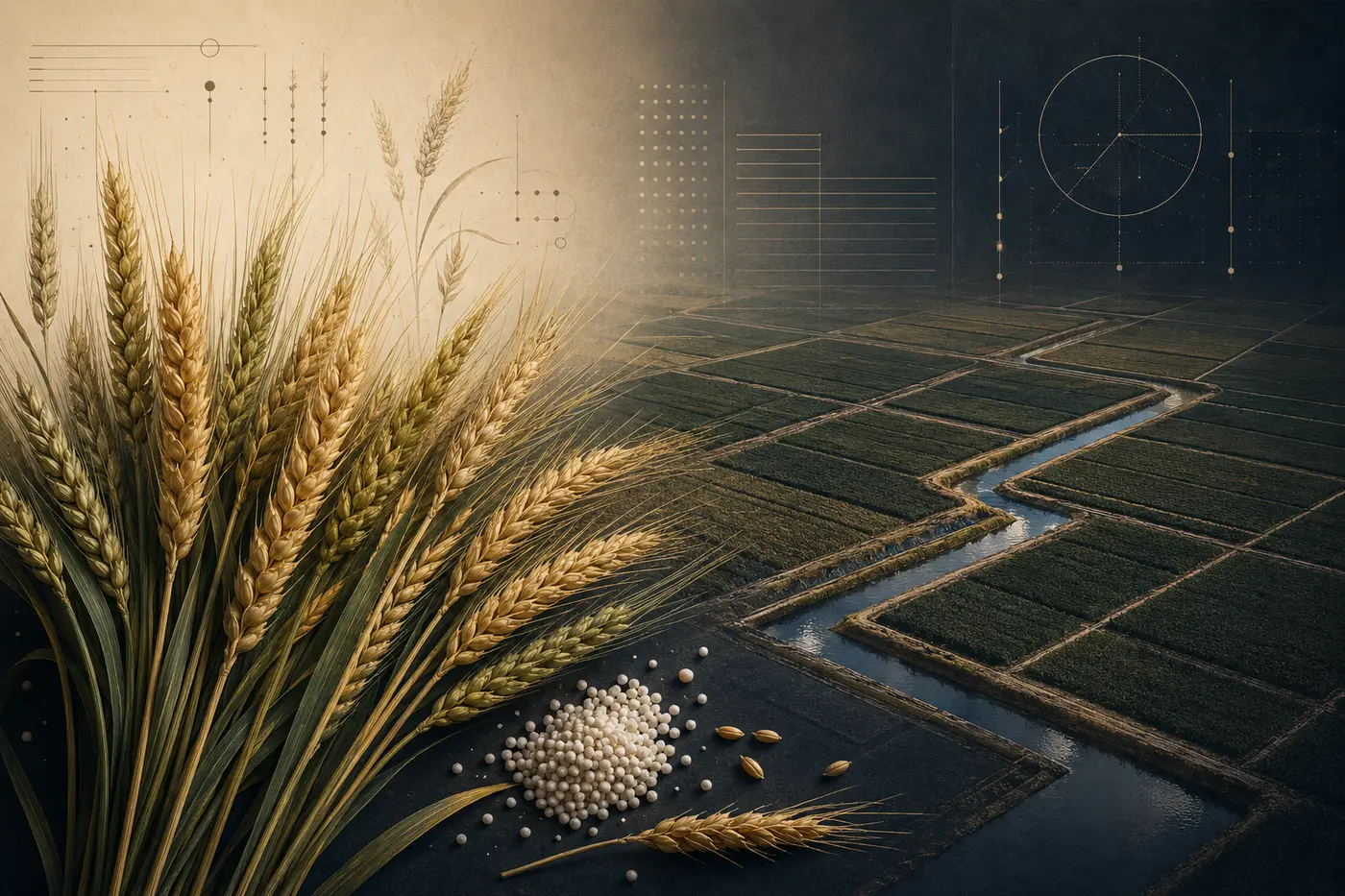
Conceptual editorial image. It illustrates the subject and is not documentary evidence.
Mid-twentieth-century breeding, irrigation and fertilizer programs sharply increased yields in several regions.
Yields against a feared shortage
During the mid-twentieth century, crop breeding, irrigation, fertiliser, pesticides, credit and extension programmes combined to raise cereal yields in parts of Asia and Latin America. High-yielding wheat and rice varieties were important, but they did not operate alone. The package depended on institutions and inputs.
The results were substantial in many regions. Food production grew faster than pessimistic forecasts had expected. Yet benefits varied. Farmers with irrigation, land and credit were often better positioned to adopt the package than those without them.
Mid-twentieth-century population growth and recurring food crises created fears that production would fail to keep pace with demand. Governments and foundations invested in crop breeding, irrigation, fertilizer, plant protection and extension systems. The work later grouped under the Green Revolution was not one invention but a coordinated package.
Its most visible symbols were high-yielding varieties of wheat and rice. These plants could convert fertilizer and water into more grain and were bred with traits such as shorter stems that reduced lodging. Their performance depended on the conditions around the seed.
Mexico, wheat and institutional breeding
Research programmes in Mexico helped develop improved wheat varieties and breeding practices associated with Norman Borlaug and collaborators. The work crossed national and institutional boundaries, combining plant science with disease resistance, testing and farmer adoption.
The heroic-inventor version misses the surrounding system. Breeders required experimental stations, public funding, seed multiplication, agronomists, transport and governments willing to alter agricultural policy. A successful variety is biological knowledge packaged inside institutions.
The International Rice Research Institute developed varieties including IR8, which produced striking yields under favourable management. Adoption spread in parts of Asia alongside irrigation investment, input subsidies and procurement policies.
Results varied because farms differed in water control, soil, credit and access to markets. A seed that performed impressively on a research station could not erase the constraints facing a rain-fed farmer. The technology expanded potential; institutions determined who could reach it.
Yield is not the same as food security
Higher national production can reduce scarcity and pressure on prices, but hunger also depends on income, distribution, conflict, health and household power. The Green Revolution changed the supply side of the equation more directly than it changed entitlement to food.
This distinction prevents two opposite mistakes: dismissing yield gains because hunger survived, or declaring hunger solved because fields produced more. Production is necessary in many settings, but food security is a social outcome.
Adoption depended on farmers testing varieties against local knowledge, labour and risk. A higher average yield did not guarantee acceptance if the crop tasted wrong, matured at an inconvenient time or required cash a household could not safely borrow. Farmers evaluated the package through livelihood rather than experiment-station output.
Accounts that portray tradition as simple resistance miss this rationality. A family facing one catastrophic harvest has a different risk tolerance from a state seeking national production growth. Successful extension translated between those scales instead of assuming one metric settled the choice.
Infrastructure made biology scalable
Canals, rural roads, electricity and storage allowed improved crops to perform and reach markets. These investments often preceded or accompanied the celebrated seed. Where infrastructure was missing, biological potential remained stranded.
This interaction explains why copying one input rarely reproduces another region’s success. Technology transfer must identify complementary systems and local constraints. Otherwise, failure is blamed on farmers for not achieving results that depended on public assets they never received.
Food production rose, while environmental pressures and unequal access complicated the record.
Success altered the system around it
Higher yields supported population growth and reduced pressure to convert still more land in some settings. At the same time, intensive fertiliser and water use contributed to pollution, soil stress and depleted aquifers. Crop uniformity could also narrow resilience.
The ledger resists a single moral. Calling the Green Revolution either salvation or disaster erases the central fact that large interventions distribute gains and costs unevenly. The correct unit of analysis is not only the seed, but the system that makes the seed productive.
Evenson and Gollin estimated that improved crop varieties made a substantial contribution to production growth across developing countries between 1960 and 2000 (Evenson and Gollin, 2003). Those gains helped reduce the land area that would otherwise have been needed for the same output.
Benefits were not uniform across crops or regions. Irrigated areas and farmers able to obtain inputs often advanced faster. Some rain-fed and marginal environments received less suitable research attention, widening differences even while aggregate supply improved.
Farming became more input-dependent
High-yield systems often relied on reliable water, synthetic fertilizer, pesticides, machinery and credit. This could raise income when harvests and prices were favourable. It also exposed farmers to input costs, debt and failures outside their direct control.
Dependency is not automatically evidence of failure; all agriculture depends on systems. The important question is whether farmers have resilient choices, fair access and support when a tightly coupled production model encounters drought, price spikes or supply disruption.
Intensive irrigation contributed to groundwater depletion and salinization in some regions. Fertilizer runoff affected waterways, while pesticide use created ecological and health concerns. Repeated cultivation of a narrow crop portfolio could reduce on-farm diversity.
These costs did not negate the calories produced. They changed the accounting period. A policy judged over five harvests may look different when soil, aquifers and pest resistance are evaluated over fifty years.
Success changed diets as well as fields
Programmes often prioritized staple cereals because calorie shortages were urgent and yields were measurable. This focus could improve basic supply while giving less attention to pulses, vegetables and diverse local crops important for nutrition.
Food policy learned that abundant grain does not guarantee a healthy diet. The next stage requires productivity, affordability and nutritional diversity to be pursued together rather than sequentially.
For governments dependent on imports or food aid, domestic yield growth offered strategic as well as humanitarian value. It reduced vulnerability to foreign supply and demonstrated state capacity. Procurement and price policies became part of the national development bargain.
That political success can make reform difficult. Subsidies designed for an earlier production emergency may survive after environmental conditions change. Farmers organize livelihoods around the rules, making abrupt correction both unjust and destabilizing.
Public procurement stabilized the new system
Guaranteed prices and government purchasing reduced market uncertainty in some regions, encouraging investment in fertilizer and irrigation. Storage and distribution then connected farm output to national food policy. The technology and the policy became mutually reinforcing.
This means later reform cannot isolate the seed from the subsidy structure built around it. Removing one element changes incentives across the package. Transition plans must protect farmers who made rational investments under earlier rules.
Pumping allowed farmers to buffer unreliable rainfall and intensify cultivation. When extraction exceeded recharge, each successful harvest drew down a hidden reserve. The field could look productive while the underlying system became less resilient.
Groundwater illustrates why environmental accounts need stock as well as flow. Annual yield measures the crop; aquifer level measures whether the same method can continue. Both belong in the ledger.
Seed diversity is an insurance system
Uniform varieties simplify cultivation and markets, but genetic similarity can increase shared vulnerability to disease or changing conditions. Seed banks, public breeding and continued cultivation of diverse crops preserve options that may not appear profitable in an ordinary year.
Diversity should not be romanticized as automatically high-performing. Its value includes resilience and future breeding material—benefits that markets may underprice because they are collective and long-term.
Mechanization and multiple cropping altered demand for seasonal work. Some farmers expanded and hired more labour; others displaced workers or consolidated land. Effects varied by crop, region and policy.
Aggregate yield statistics cannot show who gained income or lost bargaining power. A complete assessment follows value through landowners, tenants, labourers, input suppliers and consumers. Food can become cheaper while a particular rural household becomes less secure.
The useful lesson is neither triumph nor condemnation, but attention to the whole system around an innovation.
The next yield problem
Agriculture now faces climate stress, biodiversity loss, changing diets and the need to reduce environmental damage. New breeding techniques, precision agriculture and better management may help, but technology will again arrive through land rights, markets, infrastructure and policy.
The durable lesson is to preserve ambition while widening the accounting. Measure yield, nutrition, farmer risk, water, soil and access together. A solution remains a solution only if the surrounding system can carry it.
Future crops must perform under heat, irregular rainfall, new pests and water constraints. Maximizing yield under ideal input conditions is no longer sufficient. Stability across stressful years may be more valuable than a record harvest followed by collapse.
Breeding, gene editing, agronomy and farmer knowledge can all contribute. The historical lesson is to evaluate the whole package around a promising trait, including ownership, seed access and the conditions under which performance claims were produced.
The next revolution should be plural
No single model fits irrigated plains, drylands, small island systems and urban-adjacent agriculture. Precision tools may reduce inputs on some farms; agroecological practices may build resilience on others. Public research should preserve options rather than turning one successful package into a universal prescription.
Plurality is harder to administer because it resists one headline metric. It is also more resilient. A food system with diverse crops, suppliers and practices is less likely to share one point of failure.
The Green Revolution deserves neither uncomplicated celebration nor retrospective condemnation. It contributed to enormous production gains and carried environmental and distributional costs. Both statements can be true without cancelling each other.
The useful practice is full-cost accounting: calories, income, water, soil, health, biodiversity, debt and resilience. A technology becomes mature when its supporters can measure the consequences that do not fit on its original scorecard.
Fertilizer security has become geopolitical
Nitrogen production depends heavily on energy, while phosphate and potash supply is geographically concentrated. Conflict, export restrictions and energy prices can therefore enter farm budgets through fertilizer. A high-yield system becomes exposed to industrial and geopolitical shocks far from the field.
Efficiency, recycling and diverse nutrient strategies can reduce exposure. The aim is not purity from external input, but fewer single points of failure and better matching of application to plant need.
A system optimized for average output may fail abruptly under heat, flood or input shortage. Resilience metrics should include yield stability, recovery time, farmer debt, water condition and access to alternatives.
The Green Revolution proved that coordinated science and policy can change food supply. Its next lesson is that coordination must now include the consequences success left outside the original target.
Open research capacity is strategic resilience
Public breeding programmes preserve the ability to respond to diseases and climates that may not promise immediate commercial return. Private innovation can add speed and investment, but concentrated ownership may narrow access or research priorities.
A resilient system uses clear intellectual-property rules, seed conservation and collaboration so emergency breeding material and knowledge remain available. The next breakthrough should not create one new dependency while solving another.
The Green Revolution altered the feared arithmetic of food supply in many regions. Dismissing that achievement ignores real harvests and lives. Treating it as a finished triumph ignores groundwater decline, input dependence, uneven access and nutritional gaps that became clearer over time.
A fair evaluation must compare plausible alternatives, not perfection. Without yield growth, more land might have been cultivated and food pressure could have been worse. Yet the existence of a counterfactual benefit does not excuse avoidable damage. It establishes a stronger obligation to preserve the gain while correcting the package.
The most useful inheritance is institutional confidence: coordinated research, policy and infrastructure can transform food systems. The next transformation needs a broader target. It must reward productivity that can persist through climate stress, protect soil and water, improve diet and leave farmers with choices. Yield remains essential; it is no longer sufficient as the whole scorecard.
That broader target will be harder to communicate because no single miracle variety can represent it. Progress may look like lower fertilizer loss, stronger local seed systems, reduced debt volatility and a harvest that remains adequate in a bad year. These quieter gains deserve the same political attention once reserved for record yield.
A technical success should be judged by the hunger it prevented and the dependencies it created.
References
Sources are listed in Harvard author–date format. Links are provided where a stable public record is available.
- Evenson, R.E. and Gollin, D. (2003) ‘Assessing the impact of the Green Revolution, 1960 to 2000’, Science, 300(5620), pp. 758–762. doi:10.1126/science.1078710.
- Pingali, P.L. (2012) ‘Green Revolution: impacts, limits, and the path ahead’, Proceedings of the National Academy of Sciences, 109(31), pp. 12302–12308. doi:10.1073/pnas.0912953109.
- Hazell, P.B.R. (2009) The Asian Green Revolution. IFPRI Discussion Paper 00911. Washington, DC: IFPRI.