The Box That Rewired World Trade
The shipping container changed trade because ports, cranes, ships, roads, rail and standards agreed around it.
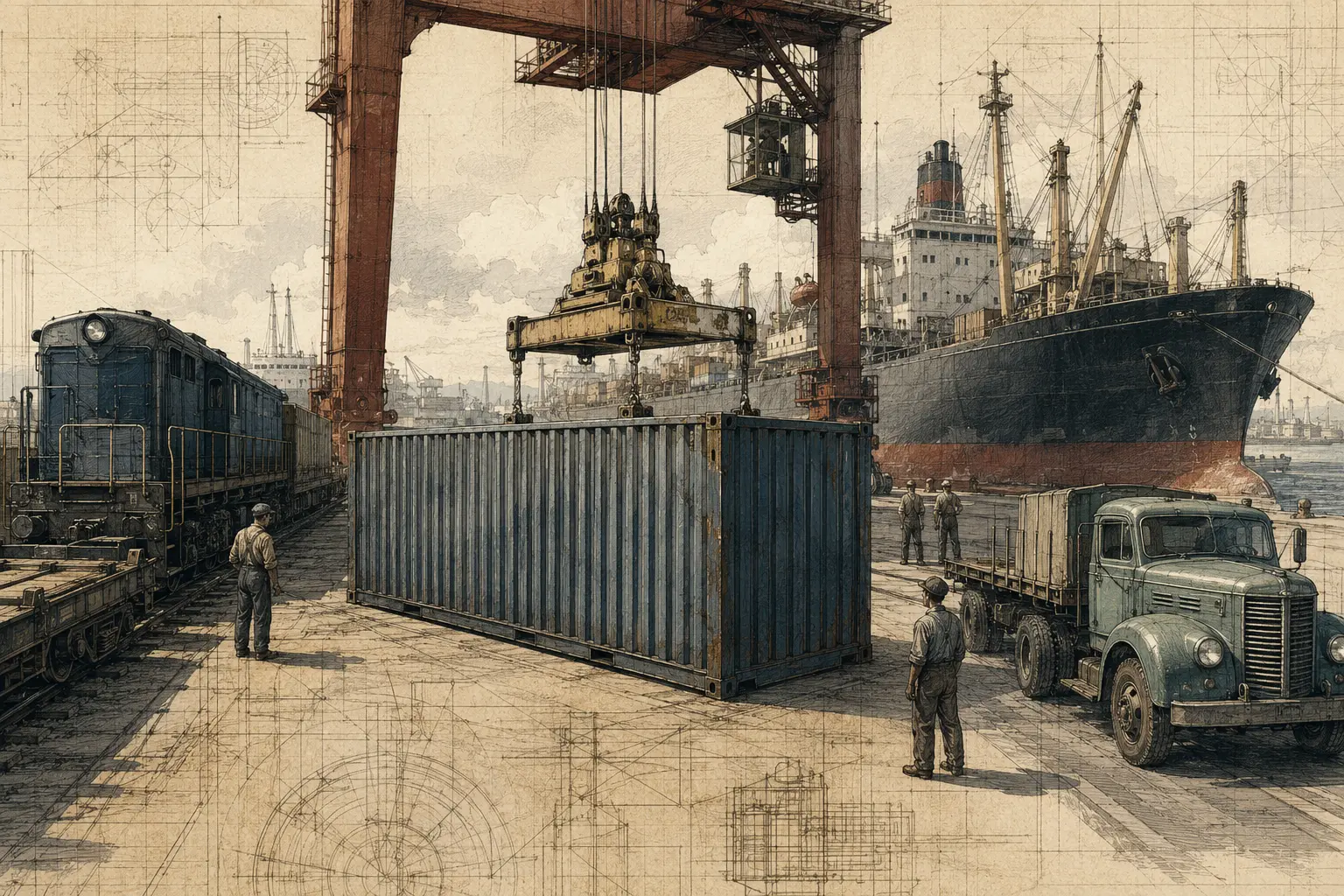
The container’s power came not from the box alone, but from making ships, cranes, railways and roads operate as one system. Then and Therefore Editorial Team. Conceptual editorial image generated for this article; it is not documentary evidence.
The 1956 Ideal X voyage demonstrated a commercial system; Sea-Land, military logistics, port investment and ISO standards made it interoperable.
Why This Matters
The shipping container is a plain steel box. Its power lies in everything that agrees to treat the box the same way.
A crane can lift it from ship to train. A truck chassis can receive it without unloading the cargo. Ports can stack it, insurers can classify it, customs officers can seal it and firms can plan around its dimensions. Goods spend less time being handled piece by piece and more time moving through a coordinated system.
The usual story begins on 26 April 1956, when the converted tanker *Ideal X* left Port Newark carrying 58 containers under the direction of trucking entrepreneur Malcolm McLean. The voyage was a landmark. It was not the first use of containers, nor did one ship create global trade.
Containerization succeeded when boxes, corner fittings, cranes, ships, railcars, roads, standards, contracts and ports became compatible. That system lowered some costs dramatically while redistributing work, investment and risk. Old waterfront jobs disappeared or changed. Ports moved. Warehouses and factories reorganized around long supply chains. Environmental burdens grew around shipping corridors.
The box rewired world trade because institutions rebuilt the world around it.
Before modern containerization, much general cargo traveled as break-bulk: sacks, barrels, crates, machinery and bundles loaded and secured separately. A ship could spend days in port while workers moved goods between quay, hold, warehouse, rail and truck. Each transfer created delay, labor cost, damage and opportunities for theft.
Containers had precedents. Railways and shipping lines experimented with reusable boxes before the 1950s. The challenge was not imagining a container. It was making the container economically useful across competing transport systems.
McLean approached the problem from trucking. Rather than move an entire trailer body onto a ship, his system separated the cargo box from the wheels. The *Ideal X*, a converted World War II-era tanker, carried 58 metal containers from Newark to Houston in 1956. Port records preserve the voyage because it demonstrated a viable commercial service, not because no box had ever traveled before.
The demonstration still left major questions. What size should the box be? How strong? Where should lifting and securing points sit? Would railways accept dimensions designed for American roads? Would ports invest in specialized cranes before enough ships used them? Would shipping lines order cellular vessels before ports could handle them?
These are coordination problems. Each participant benefits from compatibility, but early adopters risk being stranded with the wrong standard.
McLean’s company, later Sea-Land, built an integrated system with ships, terminals, containers and inland connections. Other firms pursued alternatives. The United States military’s logistics demands, especially during the Vietnam War, helped expand container use and demonstrate the value of sealed intermodal movement at scale.
International standardization was decisive. ISO created Technical Committee 104 on freight containers in 1961. Standards addressed dimensions, ratings, terminology, testing and corner fittings. ISO 668 became a central reference for Series 1 freight containers. The familiar twenty-foot equivalent unit, or TEU, reflects the standardized twenty-foot container as an accounting measure, even though fleets include several lengths and specialized designs.
Standards did not eliminate politics. Firms and countries had invested in different sizes. Roads, rail clearances and port equipment varied. ISO’s institutional history shows that multiple series were initially accommodated before market adoption converged strongly around Series 1. The final standard was not simply the mathematically perfect box. It was a negotiated basis for investment.
Ports then had to be rebuilt. Container terminals require large cranes, storage yards, road and rail access, information systems and deep-water berths. Traditional finger piers near city centers were often poorly suited to the new geography. Activity shifted toward terminals with land and highway connections, such as Port Newark–Elizabeth.
Labor changed with the port. Fewer workers were needed to handle each ton of cargo directly. Jobs moved toward crane operation, equipment maintenance, trucking, warehousing and logistics management. Waterfront unions negotiated over job loss, jurisdiction and compensation. Productivity gains were real; so were the communities asked to absorb them.
Faster intermodal transfer lowered friction, shifted industrial geography and made long supply chains operational at global scale.
Therefore
Containerization reduced the “friction of distance” for many manufactured goods. Sealed cargo needed less repeated handling. Transfer between modes became faster. Schedules grew more predictable. Firms could source components and serve markets across greater distances.
But the box did not lower every cost equally. Heavy investment favored large ports, large carriers and high-volume routes. Inland transport, terminal congestion, customs delay and empty-container repositioning remained expensive. Savings depended on the surrounding network.
The system also changed industrial geography. Factories no longer needed to sit beside the old break-bulk waterfront. Distribution centers clustered near highways and intermodal hubs. Retailers could manage inventories across oceans. Production fragmented into stages located in different countries.
That fragmentation supported lower consumer prices and export-led growth in some regions. It also made local employment more exposed to distant competition and policy. Containerization did not cause globalization alone; trade liberalization, communications, finance and corporate strategy mattered. The box made certain global strategies operational.
Standardization created visibility and blindness at once. A container can be tracked as a unit while its contents remain sealed. That improves security and reduces pilferage, but it can complicate inspection. Customs systems use manifests, risk scoring and scanning to decide which boxes to open. The efficiency of the system depends on selective trust.
Environmental consequences also spread across scales. Moving goods by large ship can be energy-efficient per tonne-kilometer, yet the enormous volume of trade produces emissions, air pollution near ports, underwater noise and ecological risks. Truck traffic burdens nearby communities. Bigger ships can reduce unit costs while requiring dredging, larger cranes and concentrated terminals.
The pandemic-era supply disruptions exposed another consequence. Container networks are efficient when equipment, vessels, labor and port capacity remain synchronized. A shock in one region can leave boxes and ships in the wrong places. The container did not make supply chains fragile by itself. It made their dependencies tightly coupled and globally consequential.
Future logistics should pair compatibility and decarbonization with resilience, full-network cost accounting and fair transition bargains.
What Next
The next logistics revolution will probably look less dramatic than the first container voyage. It will involve data standards, cleaner fuels, automated terminals, better tracking and decisions about where resilience should replace maximum utilization.
Three lessons from containerization should guide it.
First, compatibility creates more value than novelty alone. A brilliant device that cannot enter existing systems remains an island. Standards can be slow because they coordinate investments that must last for decades.
Second, efficiency has geography. Every saved minute appears somewhere: fewer dock hours, larger yards, more truck movements, changed jobs or relocated pollution. Evaluation should follow costs across the whole network.
Third, redundancy is not always waste. Spare capacity, diverse routes and buffer inventories look inefficient in a stable spreadsheet. During disruption they become insurance. The correct amount depends on the consequence of delay, not one universal formula.
Finally, transition bargains matter. Workers and communities asked to carry concentrated losses should not be treated as obsolete parts. The history of ports shows that a system can become more productive while making its politics harder.
The container’s genius was not its shape. It was the agreement embedded in the shape. A box became infrastructure when thousands of actors could act on it without renegotiating what it was. The future of trade will depend on the same achievement: not merely moving more, but deciding what the system should optimize—and who gets to write the standard.
The container’s genius was not its shape. It was the agreement embedded in the shape.
References
Sources are listed in Harvard author–date format. Links are provided where a stable public record is available.
- Port Authority of New York and New Jersey (2026) ‘Shipping Containerization, Born at Port Newark, Marks 70 Years’.
- Port Houston (2026) ‘Ideal X’.
- International Organization for Standardization (2017) ‘Boxing clever—How standardization built a global economy’.
- Levinson, M. (2016) The Box. 2nd edn. Princeton: Princeton University Press.
Further reading
- Port Authority of New York and New Jersey (2026) ‘Shipping Containerization, Born at Port Newark, Marks 70 Years’.
- Port Houston (2026) ‘Ideal X’.