When Cheap Light Made the Night Longer
Cheap illumination expanded the possible night. Institutions and people decided what to do with it.
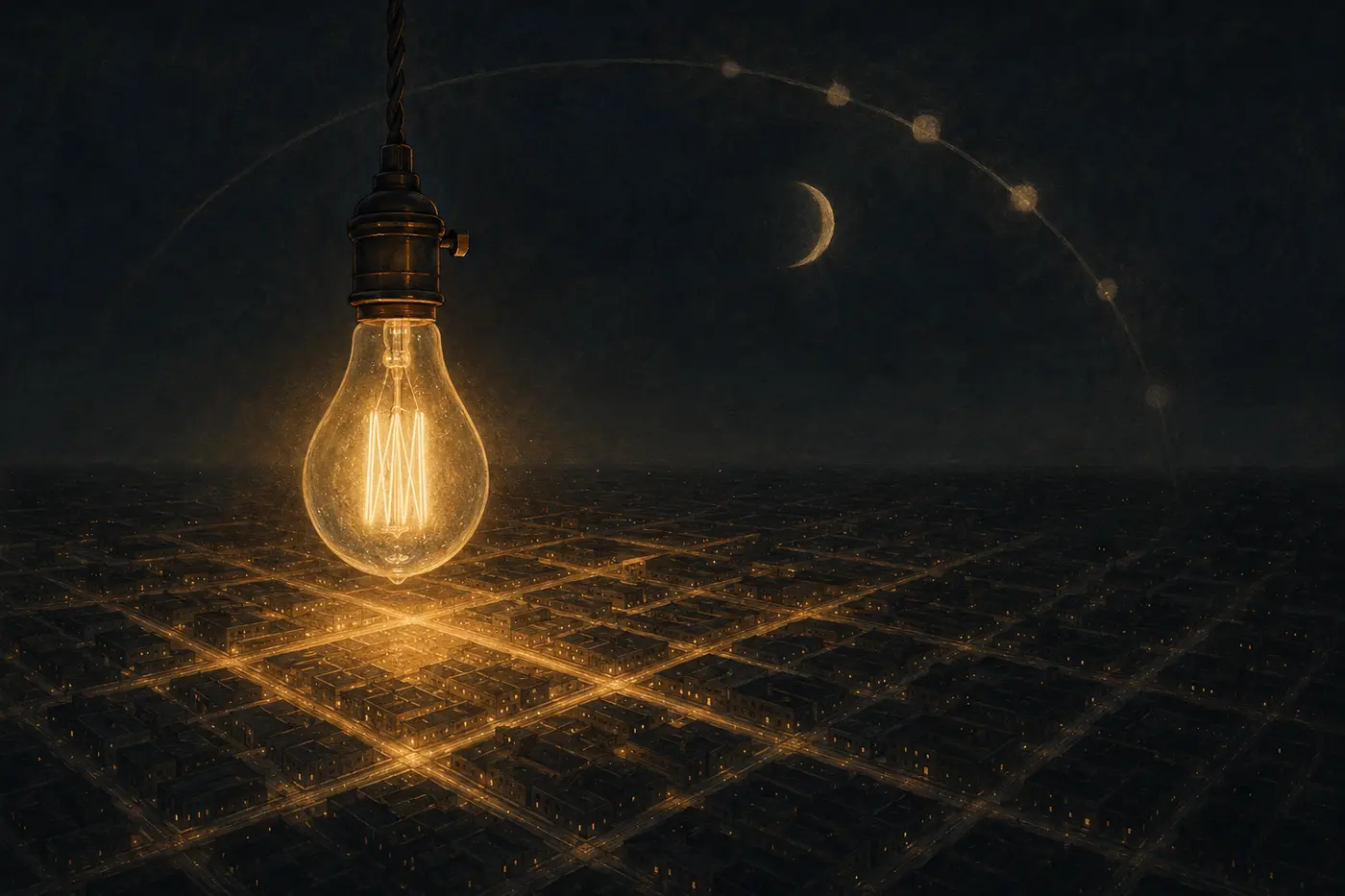
Conceptual editorial image. It illustrates the subject and is not documentary evidence.
Gas networks preceded widespread electric lighting; both depended on infrastructure and spread unevenly while the cost of useful illumination fell radically.
Why This Matters
For most of human history, darkness was expensive to resist.
A flame could push back the night, but only by consuming something valuable: wax, oil, tallow, wood or gas. Light had to be tended. It smoked, smelled, heated rooms and sometimes burned them down. People worked and socialized after sunset, of course, but illumination imposed a cost that daylight did not.
Then the price of usable light began to collapse.
Gas networks lit factories, streets, shops and some homes. Electric systems eventually made illumination cleaner at the point of use, easier to control and progressively cheaper. Later fluorescent lamps and LEDs produced far more light from each unit of energy. The result was not simply a brighter version of the old evening. Artificial light became infrastructure: a condition that allowed cities, offices, hospitals, entertainment and household life to operate on schedules increasingly detached from the sun.
It is tempting to reduce this transformation to Thomas Edison and one bulb. That misses both the long history before electricity and the system that made an electric lamp useful. It is equally tempting to claim that cheap light straightforwardly stole human sleep. Modern research shows that light can alter circadian timing, alertness and sleep. It cannot, by itself, reconstruct how much people slept in every past society.
The durable story lies between those shortcuts. Cheaper light expanded the possible night. Institutions and people decided what to do with it.
Before industrial lighting, households combined darkness, firelight and small lamps in ways shaped by income, fuel and custom. Candles varied enormously in price and quality. Oil lamps improved over time, but their fuel, maintenance and limited brightness still mattered. Darkness was never absolute, yet light remained a scarce service.
That word—service—is important. People do not consume a candle or a kilowatt-hour for its own sake. They want illumination: enough visible light, for enough time, in the right place. Economist William Nordhaus used the history of lighting to show why conventional price measures can miss technological change. Comparing the cost of fuels alone understates the improvement because newer systems delivered much more useful light from the resources consumed.
The first great industrial break was gas, not electricity.
Coal-gas lighting developed in Britain around the end of the eighteenth century and spread during the nineteenth. Gasworks produced fuel centrally and delivered it through pipes. That network could illuminate large interiors and streets more consistently than individually managed candles or oil lamps. Baltimore introduced gas streetlights in 1816, according to the Smithsonian’s lighting history.
Gaslight changed the scale of illumination, but not evenly. A district needed pipes, capital, maintenance and customers able to pay. Public streets, factories, theaters and commercial centers could be connected before poorer or remote households. Gas flames also generated heat, consumed oxygen and introduced fire, leakage and pollution risks.
Still, gas made sustained brightness practical in places where it had previously been costly or cumbersome. It could support evening retail, entertainment and industrial work. It could make streets more navigable after dark. Yet the existence of light did not by itself determine working hours. Factory discipline, wages, labor law, transport and employer power mattered. Technology made longer operation possible; institutions determined whether that possibility became overtime, a night shift, safer movement or leisure.
Electric lighting emerged through another long sequence of inventions. Arc lamps produced intense light suitable for streets and large spaces before incandescent lamps became common. Many experimenters worked on filaments, vacuums, generators and electrical distribution. Joseph Swan developed working incandescent lamps in Britain. Thomas Edison and his collaborators produced a durable high-resistance lamp and, crucially, worked on a commercial system around it.
The U.S. Department of Energy’s historical account emphasizes this system: generators, distribution wires, conduits, meters and a utility capable of supplying customers. Edison modeled parts of the business and distribution logic on gas lighting. Pearl Street Station began supplying electricity in lower Manhattan in 1882.
A bulb without reliable power was an object. A bulb connected to generation, distribution, metering, finance and maintenance became a service.
Early electric light did not sweep gas away overnight. Competing systems differed in cost, safety, brightness, location and purpose. Gas companies improved their own technologies. Electricity spread through dense commercial districts, wealthy homes and industrial sites before reaching everyone. Rural electrification came much later in many countries.
Even within electricity, the useful product kept changing. Carbon filaments gave way to longer-lasting and more efficient tungsten. Fluorescent lighting transformed large workplaces. LEDs later produced more light per unit of electricity and allowed fine control over color, direction and timing.
Across these transitions, the cost of illumination fell by orders of magnitude. Nordhaus’s historical estimates are necessarily constructed from assumptions about light output, fuel prices, lamp efficiency and labor. The exact ratio depends on the chosen dates and measures. The direction does not: an hour of useful light became radically cheaper.
When a service becomes cheap, people often consume much more of it. Rooms become brighter. More spaces are illuminated. Lights stay on longer. Streets, signs, offices and buildings join into luminous environments. Efficiency can reduce the energy needed for a particular amount of light while total lighting still grows—a rebound pattern that complicates simple claims about savings.
The social consequences were varied.
Shops could remain open after sunset. Readers and students gained more convenient evening hours. Theaters and restaurants could offer new experiences. Hospitals and emergency services could operate under dependable illumination. Public lighting made nighttime movement more legible, though claims that it automatically eliminated crime are harder to establish.
Work also expanded into the night. Illumination enabled production schedules less constrained by daylight, but it was not the sole cause of long industrial hours. Steam power, factories, time discipline, transport, wage relations and regulation all shaped labor. Some workers experienced light as opportunity or safety; others experienced it as an employer’s ability to command more of the day.
The home changed too. Electric switches reduced the effort of lighting and extinguishing a room. Compared with flames, electric lamps did not consume indoor oxygen or release combustion products at the point of use. Yet domestic adoption depended on wiring, appliance markets, housing and income. “The night became longer” at different times for different people.
Then there is sleep.
Human circadian systems respond to light. Modern experiments and reviews show that evening and nighttime light can suppress melatonin, shift circadian timing, increase alertness and affect sleep, with effects depending on intensity, spectrum, duration, timing and individual sensitivity.
That is a physiological mechanism, not a historical sleep ledger.
Researchers disagree about how to interpret evidence for preindustrial sleep patterns, including claims about widespread “first” and “second” sleep. Diaries, medical texts, legal records and ethnographic comparisons are informative but incomplete and socially selective. Artificial light plausibly changed when many people could remain active, and modern evidence explains how light can influence bodies. It does not prove that every population slept a particular number of hours before electrification or lost a uniform amount afterward.
The record supports several careful distinctions:
- **Fact:** successive lighting technologies greatly reduced the resource cost of useful illumination. - **Fact:** gas lighting preceded widespread electric lighting and required its own urban infrastructure. - **Fact:** practical electric lighting was a system of lamps, generation, distribution, metering and institutions—not one isolated invention. - **Fact:** light can affect human circadian timing, alertness and sleep under modern experimental conditions. - **Interpretation:** cheap light expanded society’s usable night, while labor markets, law, income and culture shaped whether the added hours became work, commerce, leisure or rest. - **Informed possibility:** artificial lighting contributed to historical changes in sleep timing and duration, but the size and universality of that effect cannot be inferred from modern physiology alone.
Artificial light turned nighttime from a recurring physical limit into a managed environment whose benefits and burdens depend on schedules, institutions and power.
Therefore
The deepest effect of cheap light was to turn nighttime from a recurring limit into a managed environment.
Once illumination became infrastructure, darkness stopped being merely what happened after sunset. It became something that homes, firms and cities could choose to preserve, reduce or overwhelm. A hospital could maintain constant operations. A factory could schedule shifts. A shop could compete through longer opening hours. A household could read, work or socialize late into the evening.
This flexibility created value because human needs do not always fit daylight. It also transferred power to whoever controlled schedules.
That pattern appears in many technologies. Removing a physical constraint does not determine the social outcome. It enlarges the menu of possible outcomes and changes who can choose among them. Cheap communication can connect families or extend work into every hour. Remote access can provide autonomy or erase boundaries. Cheap light could create leisure, but it could also normalize availability.
Lighting also reveals why infrastructure is easy to forget. The lamp is visible. The power station, wires, standards, financing and maintenance recede into the background. Once the system works reliably, illumination feels like a property of a room rather than the endpoint of a network.
That invisibility encourages lone-inventor myths. Edison mattered, but his importance cannot be separated from teams, competitors, earlier gas networks, utility organization and the economic problem of distributing power. Innovation became consequential when it could be manufactured, connected, priced and repaired.
The same history complicates the word “efficiency.” A more efficient lamp reduces the cost of a given amount of light. Society may then demand more lumens, more illuminated surfaces and longer operating hours. The engineering improvement is real, but its environmental result depends on total use, electricity generation and design.
Today, this is visible in light pollution. Artificial light at night can obscure stars, disrupt wildlife and expose people to poorly timed illumination. LEDs make targeted, controllable light possible, yet inexpensive light can also encourage excess. Brightness, color, shielding and timing matter alongside energy efficiency.
The future problem is therefore not simply how to make light cheaper. It is how to make illumination more deliberate.
Use lighting deliberately: match brightness, direction, spectrum and timing to the purpose while protecting sleep, workers, ecosystems and the night sky.
What Next
Good lighting policy begins by asking what the light is for.
A pedestrian crossing, hospital corridor, warehouse, bedroom and historic district have different needs. More brightness is not always more safety or better visibility. Light can be directed downward, dimmed when activity falls, selected with an appropriate spectrum and turned off when unnecessary.
At home, modern circadian evidence supports a practical distinction: bright, blue-enriched light is useful when alertness is wanted and less useful near intended sleep. That does not require recreating a preindustrial night. It means using control—one of electric lighting’s greatest advantages—to align illumination with purpose.
At work, the question is broader than lamp design. If technology makes around-the-clock operation possible, schedules, staffing, worker choice and health protections determine whether that capability is humane.
Cheap light gave society more usable hours. It did not tell us how those hours should be spent.
The next revolution in lighting may be less about defeating darkness than about recovering the ability to choose it.
Cheaper light expanded the possible night. Institutions and people decided what to do with it.
References
Sources are listed in Harvard author–date format. Links are provided where a stable public record is available.
- Nordhaus, W.D. (1996) ‘Do Real-Output and Real-Wage Measures Capture Reality? The History of Lighting Suggests Not’. National Bureau of Economic Research.
- Smithsonian National Museum of American History (n.d.) ‘Lighting a Revolution: 19th Century Competition’.
- Smithsonian National Museum of American History (n.d.) ‘Lighting a Revolution: 19th Century Invention’.
- U.S. Department of Energy (n.d.) ‘The History of the Light Bulb’.
- Blume, C., Garbazza, C. and Spitschan, M. (2019) ‘Effects of light on human circadian rhythms, sleep and mood’, Somnologie, 23.
- Ludtke, L.E. (2020) ‘Sleep, disruption and the nightmare of total illumination in late nineteenth and early twentieth-century Britain’, History of Psychiatry, 31(2).
Further reading
- Nordhaus for the constructed long-run cost of lighting service.
- Smithsonian for gas, electric and inventor-system chronology.
- Blume, Garbazza and Spitschan for modern circadian mechanisms and their limits.