The Fire That Taught Cities to Regulate Risk
After London burned, rebuilding connected safer construction, faster dispute resolution and pooled commercial risk.
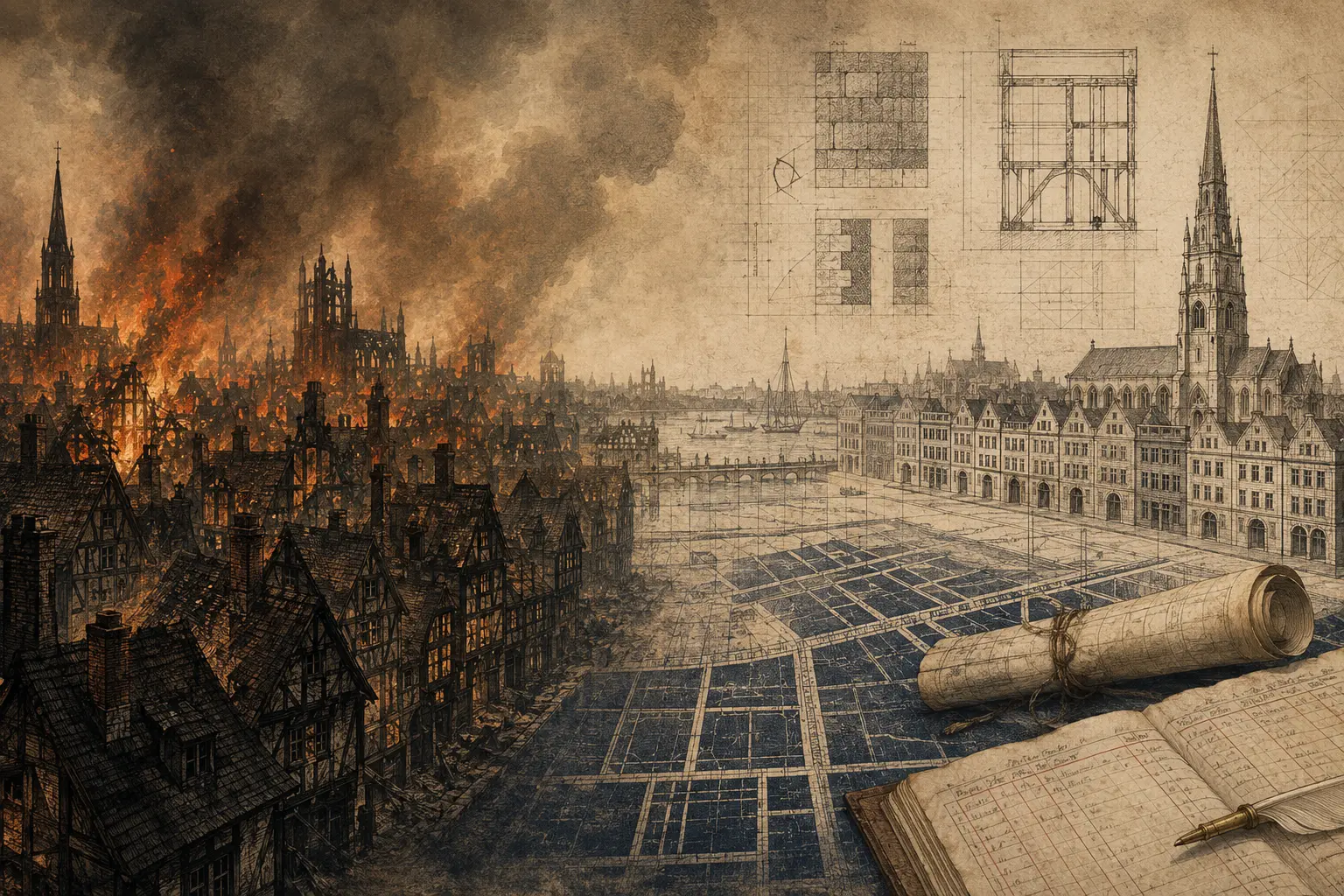
After catastrophe, cities began turning fire risk into rules, plans and institutions. Then and Therefore Editorial Team. Conceptual editorial image generated for this article; it is not documentary evidence.
The 1666 fire destroyed most of the walled City, after which enforceable rebuilding standards, a special court and public finance accelerated recovery.
Why This Matters
A building code is easy to notice only when it gets in the way. It tells a builder what materials may be used, limits heights and openings, and turns private construction into a matter of public concern. Fire insurance can feel equally ordinary: a contract priced in advance against a disaster that may never happen.
Neither institution is natural. Both rest on the same hard-earned insight: in a dense city, one owner’s risk does not remain one owner’s problem.
The Great Fire of London made that truth impossible to ignore. From 2 to 5 September 1666, flames destroyed most of the walled City of London. Parliament’s historical account lists 13,200 houses, 87 churches and 52 livery halls among the losses. Oxford historian Vanessa Harding estimates that 70,000 to 80,000 people were left homeless. The fire did not erase all of metropolitan London, and the recorded death toll was surprisingly small. But it dismantled the commercial and civic machinery of the country’s most important city.
The response is often reduced to a tidy moral: London burned because it was made of wood, then rebuilt in brick. That is true in outline and inadequate in substance. Building rules existed before 1666. Grand plans for a geometrically redesigned capital largely failed. Insurance did not spring fully formed from the ashes. What changed was the scale, enforceability and interconnection of the response. Construction standards, street controls, special courts, public finance, organized firefighting and private risk pooling began to operate as parts of a larger urban system.
The fire’s enduring lesson was not that catastrophe can be abolished. It was that shared risk can be governed before the next spark.
Seventeenth-century London was combustible by design and by accumulation. Timber-framed buildings crowded narrow lanes. Upper storeys projected over streets. Workshops, warehouses, stables, hearths and stores of flammable materials sat close together. The city had regulations and firefighting practices, but enforcement competed with property rights, guild privileges, cost and the pressure to fit more people and commerce into limited space.
When fire began in Thomas Farriner’s bakery on Pudding Lane shortly after midnight on 2 September, those conditions turned a local emergency into a chain reaction. Strong winds pushed fire through the dense urban fabric. Traditional containment depended heavily on pulling down buildings to make firebreaks, but hesitation over authorizing demolition lost valuable time. Water delivery, hand tools, hooks and small engines could not match the scale of the spread.
Four days later, roughly 373 acres inside the walls—about 85 percent of that area—had burned, according to Oxford’s account. The Royal Exchange, Custom House, Guildhall, prisons, parish churches and thousands of homes were gone or damaged. Yet city government did not simply disappear. Officials relocated operations, markets were improvised, parishes continued administrative work and royal troops helped maintain order. The same institutions that had struggled to prevent the disaster proved capable of organizing recovery.
That recovery began with an argument over what kind of city should return.
Christopher Wren, Robert Hooke and John Evelyn proposed ambitious new street plans. Their designs promised broader avenues, regular blocks and monumental vistas. They are visually persuasive even now, which is why the rebuilding is sometimes remembered as a missed chance to remake London from a blank sheet.
But London was not blank. Beneath the ruins were property boundaries, leases, mortgages, commercial claims and people who needed homes and shops restored quickly. A fully redesigned street grid would have required surveying, compulsory purchase and compensation on a scale the political system could not finance. The old pattern of streets therefore survived far more than the famous plans suggest.
The more consequential change came through rules that could be applied within that inherited pattern.
King Charles II called for rebuilding in brick or stone less than two weeks after the fire. The first Rebuilding Act received royal assent in February 1667. Parliament’s surviving account emphasizes its requirements for brick or stone construction and its limits on house height and storeys. The legislation also created a framework for surveyors, street widening and standardized classes of buildings. Later measures refined the system.
These were not humanity’s first fire regulations, nor London’s. Earlier Stuart governments had tried to restrict timber construction and projecting upper floors. The distinction, as Oxford’s historical analysis notes, was that the post-fire rules had greater force and were applied during a rebuilding program of extraordinary scale. A regulation that exists on paper is different from one embedded in thousands of simultaneous construction decisions.
Enforcement alone could not solve the central problem: ruins were layered with conflicting legal obligations. A tenant might lack the money to rebuild; a landlord might depend on rent that no longer existed; a long lease could make responsibility unclear. Ordinary litigation could take years while the commercial city remained broken.
Parliament therefore established the Fire Court. Its judges could adjust leases, apportion rebuilding costs and settle disputes between owners and tenants. Appeals were tightly constrained. The court did not eliminate conflict or protect every party equally, but it converted a mass of private deadlocks into decisions that allowed construction to proceed. This was risk governance through procedure: not only rules about walls, but a mechanism for deciding who would pay.
Financing was equally institutional. A levy on coal entering London supported public rebuilding, including St Paul’s Cathedral and parish churches. New brickworks expanded. Guild restrictions on builders were relaxed to increase labor supply. By 1668, construction was accelerating; by the early 1670s, much of the City’s commercial life had returned.
Private insurance developed alongside this reconstruction, though the causal story requires care. Marine insurance and other forms of risk sharing already existed. Schemes for insuring buildings had been proposed before the fire. After 1666, however, the destruction made urban fire risk newly visible and created a vast market of rebuilt property worth protecting.
Nicholas Barbon established one of the first durable fire-insurance businesses in the 1680s. Other offices followed. Premiums pooled losses across many property owners, turning rare catastrophe into a calculable commercial exposure. Insurers also had an incentive to reduce losses, and some maintained private fire brigades. Fire marks attached to insured buildings identified coverage, although the popular image of brigades refusing all help to uninsured property is too simple: uncontrolled fire threatened nearby insured buildings as well.
The important development was the feedback loop. Safer materials reduced expected loss. Insurers rewarded or required distinctions among building types. Fire brigades created organized response capacity. Surveying and recordkeeping made properties more legible. Regulation and insurance did not replace one another; each made the other more workable.
Regulation and insurance developed as complementary ways to prevent, price and pool losses that could cross property lines.
Therefore
The rebuilding transformed urban fire from an individual misfortune into a systems problem.
Before that shift, responsibility could be described in narrow terms: a careless householder, an unlucky tenant, a negligent tradesman. Those judgments did not become irrelevant. But a citywide fire revealed that the path of destruction depended on street width, building materials, water access, wind, demolition authority, legal delay and the capacity to coordinate thousands of owners. Risk belonged partly to every property and partly to the structure connecting them.
That principle now sits underneath modern safety regulation. Fire-resistant construction, compartmentation, protected exits, occupancy limits, water systems and access for responders all constrain individual choice because failure crosses property lines. The exact standards are modern; the governing logic is recognizably post-fire London.
The same logic explains why insurance became more than compensation after the event. A functioning insurer must classify risk before accepting it. That requires information about materials, use, location and loss history. Pricing then influences behavior: a hazardous building may cost more to insure, require improvement or become uninsurable. In this way, private contracts can act like a second layer of regulation.
That arrangement has advantages and dangers.
At its best, insurance spreads shocks that would otherwise ruin one household or firm. It creates reserves before disaster, funds recovery and rewards prevention. At its worst, it can exclude high-risk communities, reproduce unequal access to capital or encourage the belief that anything insurable is therefore acceptable. Regulation can also impose costs that poorer owners and tenants cannot easily bear. The rebuilding of London made the city safer, but safety was not distributed without conflict. Displaced residents, tenants, small trades and those outside privileged commercial networks did not all experience recovery in the same way.
The fire also demonstrates why catastrophes rarely produce complete reinvention. Political speeches after disaster often promise a city rebuilt from first principles. Physical and social systems resist that fantasy. Property, finance, infrastructure, memory and urgent human need favor selective change. London kept much of its street pattern but altered building materials, legal processes and risk institutions. The result was less dramatic than Wren’s unrealized plan and more durable precisely because it could be implemented.
There is a second warning in the story. Success can hide the institutions that produced it. Once brick walls, wider streets, courts and insurance worked, they faded into the background. Later generations could treat them as bureaucracy rather than as stored memory of catastrophe. This is a recurring civic problem: prevention becomes visible as cost, while the disaster it prevents remains hypothetical.
Modern cities face the same tension with new hazards. Flood maps restrict development. Seismic codes raise construction costs. Heat rules reshape buildings and streets. Wildfire zones affect materials, landscaping and insurance availability. Climate risk forces governments and insurers to decide which losses can be reduced, which can be pooled and which locations may no longer be supportable on existing terms.
The Great Fire does not provide a ready-made answer to those disputes. It does show the sequence by which a society begins to answer them:
1. A shock exposes how private decisions combine into public vulnerability. 2. Rules convert the lesson into minimum standards. 3. Courts and administrative procedures resolve the conflicts created by transition. 4. Finance and insurance spread some losses and price some risks. 5. The new system creates its own exclusions, incentives and blind spots.
Calling this “resilience” can make it sound automatic. It was not. London recovered because political authority, commercial necessity, legal improvisation and immense material labor were brought into alignment. The city did not merely bounce back. It learned—unevenly—to make fire somebody’s responsibility before the flames arrived.
Climate-era resilience needs transparent standards, transition finance and protections against shifting unavoidable risk onto those least able to bear it.
What Next
The most useful inheritance from 1666 is not a particular building material. It is a method for thinking about shared danger.
First, prevention rules should be treated as evidence-bearing institutions. When a code imposes cost, policymakers should be able to explain the loss pathway it interrupts and update the rule when evidence changes. Historical memory is strongest when it is attached to transparent reasoning, not ritual.
Second, regulation needs transition machinery. A safety requirement without financing, dispute resolution or time to comply can displace risk rather than reduce it. The Fire Court mattered because it addressed the legal knots that standards alone could not untie. Modern equivalents may include grants, insurance backstops, retrofit finance and rapid appeals.
Third, pooled risk must not become disguised abandonment. When insurers retreat from flood-, storm- or fire-prone regions, the price signal may be accurate while the social outcome remains untenable. Governments then face a choice among subsidizing risk, reducing it, relocating people or allowing protection to follow wealth. Pretending the market alone made the decision is still a decision.
Finally, cities should preserve the connection between ordinary rules and the disasters that made them necessary. The safest wall is politically fragile when nobody remembers the fire.
London’s post-1666 institutions were incomplete, contested and sometimes inequitable. They were also a decisive recognition that urban catastrophe is designed long before it happens—through materials, streets, contracts and authority. The next disaster will arrive as an event. Its scale will depend on the system waiting for it.
Catastrophe becomes governable when rules, dispute resolution and finance operate as one system.
References
Sources are listed in Harvard author–date format. Links are provided where a stable public record is available.
- UK Parliament (1667) ‘An Act for rebuilding the City of London’.
- Parliament of England (1667) An Act for rebuilding the City of London, 18 & 19 Charles II c. 8.
- Harding, V. (2016) ‘Facing up to catastrophe: The Great Fire of London’, University of Oxford Faculty of History.
Further reading
- UK Parliament (1667) ‘An Act for rebuilding the City of London’.
- Parliament of England (1667) An Act for rebuilding the City of London, 18 & 19 Charles II c. 8.