When the Secret Ballot Changed What a Vote Meant
Private marking did more than hide a choice: it weakened the ability to verify threats, bargains and political obedience.
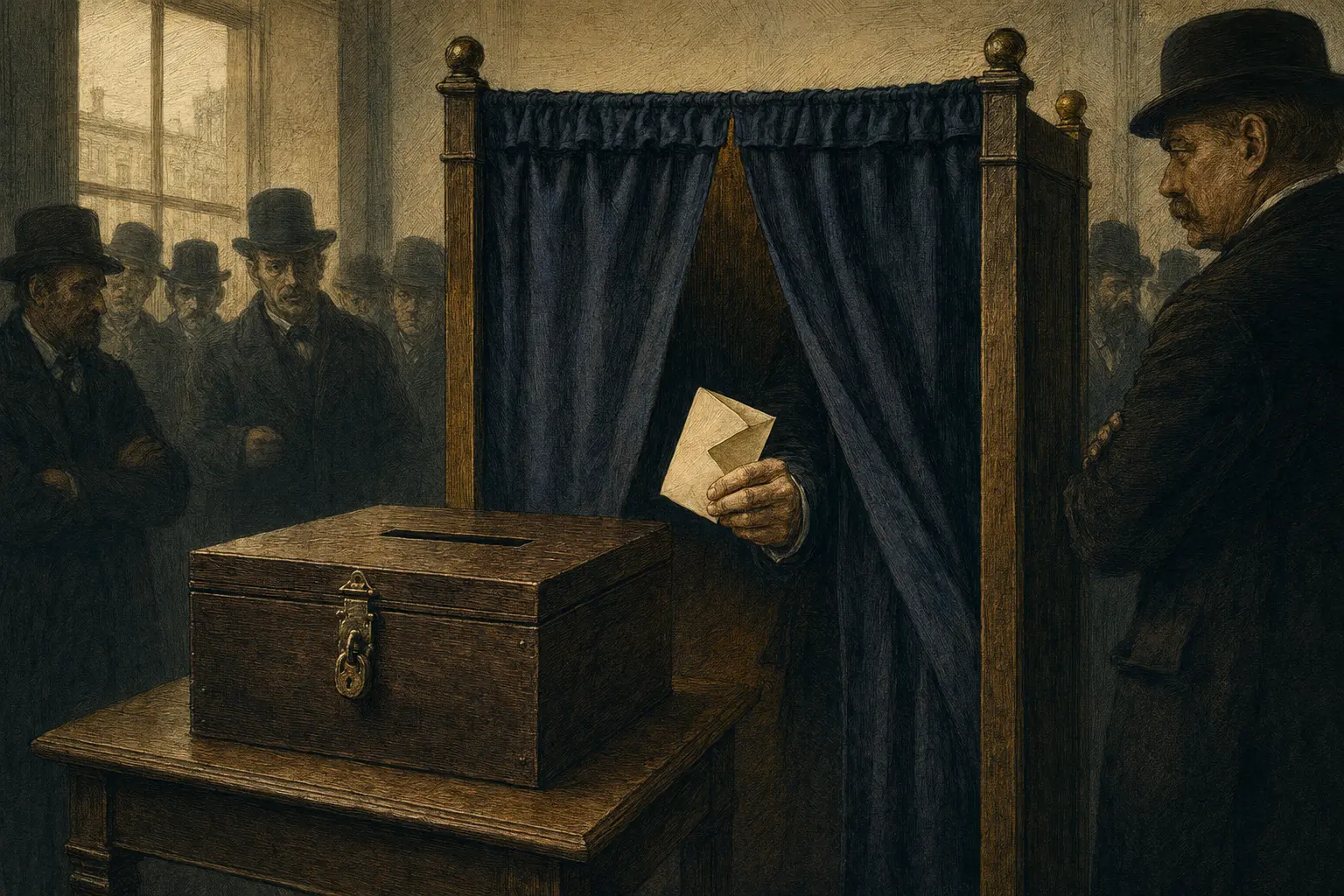
The secret ballot shifted voting from a public declaration—often exposed to pressure—toward a private civic choice. Then and Therefore Editorial Team. Conceptual editorial image generated for this article; it is not documentary evidence.
Open declarations and party-supplied tickets made votes observable to employers, landlords, brokers and bribers.
Why This Matters
Voting in private feels so fundamental that it is easy to mistake privacy for the natural condition of an election. Walk into a polling place, receive an official ballot, enter a screened space, mark a choice and deposit the paper without proving that choice to anyone. The procedure makes a political promise: your vote belongs to you.
For much of electoral history, that promise did not exist.
Voters declared choices aloud, raised hands, signed public lists or used tickets printed and distributed by political parties. Employers, landlords, patrons, party workers and neighbors could observe the act. Bribery was easier to enforce because the buyer could see whether the bargain had been honored. Intimidation worked because the target could not conceal compliance or defiance.
The secret ballot changed this relationship, but not by adding a curtain alone. What became known as the “Australian ballot” combined several features: an official ballot produced by public authority, the inclusion of eligible candidates on that ballot, controlled distribution at the polling place and private marking. Together, those rules separated political choice from public proof.
That separation redistributed power. It weakened some methods of coercion and vote buying, reduced parties’ control over ballot papers and made individual judgment harder to monitor. It also introduced new demands: literacy, standardized administration, ballot design and rules about what counted as a valid mark. Secrecy improved one dimension of electoral freedom without making elections automatically equal, inclusive or honest.
The deeper story is therefore not simply that people began voting behind a screen. A private preference became an institutional object—protected by design because law alone could not guarantee courage.
Before the secret ballot, the public character of voting was often defended rather than merely tolerated.
Open voting appeared to fit an older idea of citizenship: a voter should stand behind his judgment before the community. Public declaration could be described as honorable, masculine and accountable. Critics of secrecy worried that hidden voting encouraged selfishness or allowed citizens to evade responsibility for the political consequences of their choices.
That ideal existed alongside a less noble reality. Electoral rights were restricted by sex, property, race, status and locality. Among those who could vote, dependence shaped behavior. A tenant might fear a landlord. A worker might fear an employer. A recipient of local charity or patronage might understand which candidate powerful neighbors expected him to support. Crowds at the poll could cheer, threaten or assault voters. In systems using party-supplied tickets, the color, size or appearance of the paper could reveal a choice before it entered the box.
Bribery had the same visibility problem in reverse. A buyer does not want merely to pay for a promise; he wants evidence of delivery. Open or identifiable voting made verification possible. Secrecy undermined the transaction by allowing a voter to take money and still choose differently. The UK Parliament’s account of the Ballot Act 1872 makes this logic explicit: private voting made intimidation harder and prevented bribers from ensuring that voters acted as requested.
Reform did not begin in Britain. The phrase “Australian ballot” reflects experiments in the Australian colonies during the 1850s. Victoria and South Australia adopted systems in 1856 that used government-printed ballots and private marking. Other colonies developed related procedures. The precise claim to “first” depends on which elements are counted and on differences among the laws, which is why secrecy alone should not be confused with the complete administrative bundle.
The bundle mattered because each element closed a loophole.
If parties printed ballots, they could identify or manipulate them. If voters received papers outside the polling place, a completed ballot could be bought, exchanged or inspected. If every candidate was not listed on one official form, ballot access remained under private control. If marking was not private, intimidation survived. If the ballot box and counting process were insecure, secrecy at the booth accomplished little.
The design therefore shifted responsibility from parties and local power brokers toward the state. Election authorities had to print standardized papers, supply booths, verify eligibility, secure boxes and define valid votes. Political privacy required administrative capacity.
Britain adopted secret voting for parliamentary and municipal elections through the Ballot Act of 1872. Its official title—“An Act to amend the Law relating to Procedure at Parliamentary and Municipal Elections”—is revealing. The reform changed procedure, but procedure changed the balance of electoral power.
The first parliamentary elections under the new system did not end corruption. Treating 1872 as a magic dividing line would ignore persistent bribery, unequal constituencies, limited suffrage and the social power of wealth. The Act itself was initially temporary and renewed before the principle became permanent. Yet observers understood that a crucial mechanism had changed: it was now harder to connect a payment or threat to an observable vote.
The system spread internationally, though not in a single wave or identical form. In the United States, for example, late nineteenth-century reforms moved many states away from party-printed tickets toward government-produced ballots and private booths. Reformers presented the Australian model as protection against machine politics and electoral corruption.
That transition also produced contested effects. An official ballot could reduce party control, but it demanded that voters navigate names, offices and instructions without relying on a preprinted party ticket. Literacy requirements became more consequential. Complex ballot designs increased invalid votes. States could use ostensibly neutral procedures within broader systems that excluded Black citizens, immigrants, poor people or linguistic minorities.
Secrecy and inclusion are therefore separate achievements. A person barred from registration gains nothing from a private booth. A voter who cannot understand an official ballot may be formally free and practically disadvantaged. A polling place surrounded by violence cannot make choice safe merely by hiding the mark.
The Australian ballot was powerful because it solved a specific problem: observability. It did not solve every problem that made elections unfree.
The state-administered secret ballot made coercion and vote buying harder to verify while creating new administrative, literacy and access requirements.
Therefore
The secret ballot altered the meaning of political independence.
Under open voting, freedom had to be demonstrated in public against whatever pressure the voter faced. Under secret voting, the institution assumed that genuine preference might require concealment. The state no longer asked only whether a voter was legally permitted to choose. It accepted responsibility for making the choice difficult to observe.
This is a profound change in how law approaches power. Coercion does not always arrive as a direct command. It can live in dependence: the knowledge that a landlord, employer, spouse, clan leader, union official, party broker or armed group expects evidence of loyalty. A legal prohibition on intimidation may be weak when the vulnerable person must prove resistance in front of the intimidator. Secrecy changes the information structure itself.
That is why ballot secrecy can reduce both coercion and enforceable bribery. The voter may still be pressured or paid, but the outside actor cannot be certain how the ballot was marked. The inability to verify compliance makes threats and contracts less reliable.
The change also reshaped political parties. When parties controlled distinctive ballots and managed their distribution, mobilization could include handing supporters a physical vote. Official ballots weakened that direct control. Parties had to persuade voters before they entered the booth rather than supervise the final act. Campaigning, candidate labels, sample ballots and voter education took on greater importance.
Yet secrecy created a democratic paradox. Elections require public trust in the count while protecting the privacy of each choice. The system must prove that ballots are authentic, eligible and accurately counted without creating a record that allows outsiders to discover how individuals voted.
Modern election administration is built around that tension. Ballot papers, envelopes, voter rolls, machines, observers, audit trails and chain-of-custody rules must make the process verifiable without making the voter traceable. Too little transparency invites fraud or distrust. Too much individual traceability revives coercion.
This balance has become especially important with absentee, postal and electronic voting.
Voting at home can improve access for people who cannot easily reach a polling place. It can also move the act outside the protected environment of the booth. Family members, caregivers, employers or campaign workers may be present. Systems respond with secrecy envelopes, witness rules, signature verification and prohibitions on photographing completed ballots. Each safeguard involves trade-offs among access, privacy, verification and rejection risk.
Electronic systems raise a related challenge. A voter may want a receipt proving that the system recorded the ballot correctly. But a receipt that proves the selected candidate could also become evidence for a briber or coercer. Cryptographic voting research therefore seeks forms of verification that confirm inclusion without enabling transferable proof of the vote.
The old reform remains relevant because the underlying problem has not changed: a free election needs a choice that can be counted but not commanded.
Secrecy also helps explain why apparently small procedural violations matter. A polling booth positioned where selections are visible, a camera allowed near ballots, partisan observers standing too close or a serial number that can be connected to a voter can weaken the guarantee even if nobody is caught coercing anyone. The institution protects against the possibility of verification, because that possibility changes behavior.
At the same time, secrecy must not become an excuse for opacity in everything else. Ballot design, eligibility rules, counting procedures, audits and results should be open to scrutiny. Only the voter’s selection needs to remain secret. Democratic accountability depends on knowing how the system operates, not on knowing how a neighbor voted.
The secret ballot’s success can therefore be stated precisely:
- It made private political choice a designed condition rather than an act of personal bravery. - It weakened transactions and threats that depended on observing the vote. - It transferred control over ballot production and polling procedure toward public administration. - It did not by itself eliminate bribery, violence, discrimination, misinformation or exclusion. - It created a permanent engineering problem: how to verify the election without exposing the voter.
That is more modest than the claim that secrecy made elections free. It is also more useful. Institutions improve when we identify the mechanism they actually change.
Modern systems must preserve a privately unverifiable choice while keeping ballots, counts and audits publicly verifiable.
What Next
The future of ballot secrecy will be decided less by the existence of voting booths than by the edges of the voting process.
First, election authorities should treat coercion resistance as a design requirement. Privacy screens, polling-place layouts, rules on assistance, handling of postal ballots and protections against ballot photography should be tested against realistic power relationships, not only against formal compliance.
Second, accessibility and secrecy must be developed together. A ballot that protects privacy but cannot be independently used by a voter with a disability does not provide equal political autonomy. Assistance procedures should minimize the need to disclose a choice while preserving meaningful help.
Third, verification systems must avoid creating proof that can be sold or demanded. Auditability should demonstrate that eligible ballots were counted correctly at the aggregate level. It should not allow a voter—or someone standing over the voter—to prove a particular selection to a third party.
Finally, secrecy should be defended without romanticizing it. Private marking is one layer in a larger electoral system. Registration, districting, campaign finance, media access, physical security, counting and peaceful transfer all matter. Protecting one layer cannot excuse failure in another.
The secret ballot was a deceptively practical invention. It did not ask citizens to become fearless. It changed the rules so that fear, payment and dependence became harder to translate into a verifiable vote.
That is the quiet power of good procedure. It does not merely tell people they are free. It removes information that others could use to make freedom costly.
Secrecy solves the specific problem of vote observability, not every form of electoral exclusion.
References
Sources are listed in Harvard author–date format. Links are provided where a stable public record is available.
- UK Parliament (1872) ‘Ballot Act, 1872’.
- Museum of Australian Democracy (n.d.) ‘What is the secret ballot?’.
- The Gazette (2022) ‘The Ballot Act 1872: voting in private’.
Further reading
- UK Parliament (1872) ‘Ballot Act, 1872’.
- Museum of Australian Democracy (n.d.) ‘What is the secret ballot?’.