Why QWERTY Survived the Machines It Was Built For
The typebars disappeared. The compatibility agreement remained.
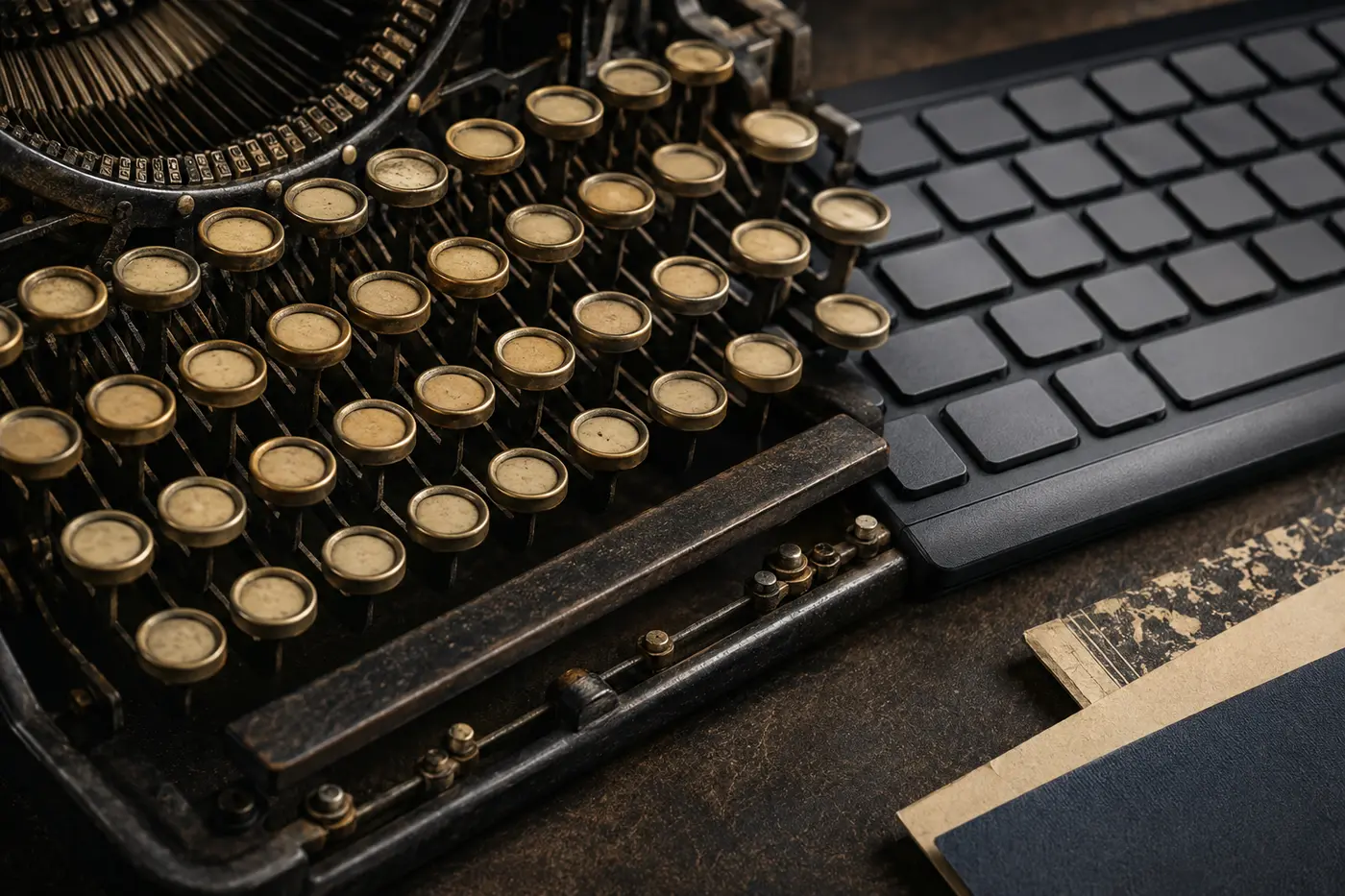
Conceptual editorial image. It illustrates the subject and is not documentary evidence.
An evolving typewriter layout gained momentum through Remington machines, touch typing and institutional training.
Why This Matters
The keyboard beneath your fingers is a fossil that still works.
Its familiar first six letters were arranged for a machine of levers, inked ribbon and paper. Those mechanisms have almost vanished from ordinary work. The arrangement has not. QWERTY crossed from nineteenth-century typewriters to teletypes, electric office machines, computer terminals, laptops and glass touchscreens. A layout shaped while inventors were still deciding what a typewriter should be now appears on devices that have no typebars to collide.
This looks like an easy parable. An awkward design won by accident; millions learned it; switching became too expensive; history trapped everyone forever. Economists have used QWERTY to illustrate path dependence—the idea that early events can steer later choices even after the original conditions disappear.
The trouble is that the strongest version of that story is not settled history.
QWERTY was not designed in one inspired moment. Surviving machines, patents and business records show an evolving layout. The popular claim that Christopher Latham Sholes deliberately scattered letters to slow typists is especially shaky. Mechanical interference mattered, but the early machines, operator practices, telegraph conventions and commercial partnership with Remington all shaped the keyboard. Later, claims that the Dvorak layout was demonstrably superior became part of another dispute. The evidence does not justify declaring either that QWERTY is optimal or that it is a proven market failure.
What survives the argument is more useful than the myth. Once a standard connects machines, training, habits, documents and expectations, it becomes more than a technical design. Its value partly comes from everyone knowing it. Replacing it means changing a system, not merely rearranging keys.
QWERTY endured because compatibility compounds.
The story begins before the object called the typewriter had settled into a stable form.
Christopher Latham Sholes, Carlos Glidden and Samuel Soule developed an early writing machine in Milwaukee in the late 1860s. Their 1868 patent described a keyboard-operated mechanism that printed characters on paper. The layout associated with the first machines was not yet the modern QWERTY arrangement. Letters moved during repeated experiments, and the machine itself changed with them.
That evolution matters because it weakens every explanation that begins with a finished modern keyboard and works backward toward one clever motive.
Koichi and Motoko Yasuoka reconstructed part of this prehistory from patents, correspondence and surviving records. Their account shows that the route to QWERTY involved successive layouts, including alphabetic and near-alphabetic arrangements, rather than a single jump from ABC order to the keyboard we know. They also identify connections with printing-telegraph practices and with users who needed to transcribe Morse messages. This does not reduce the layout to one telegraph theory. It shows that several practical environments were present while the design was still moving.
Mechanical constraints were certainly real. On early “up-strike” machines, pressing a key drove a typebar toward the underside of the platen. The typist could not immediately see the printed line. If nearby typebars rose in quick succession, they could interfere or jam. A keyboard arrangement could therefore influence the rhythm and physical interaction of the mechanism.
But “designed around mechanical interaction” is not the same as “designed to make people type slowly.” The famous slowing claim turns a complicated engineering process into a mischievous master plan. There is no strong contemporary evidence that Sholes’s objective was to suppress overall typing speed. Inventors trying to make a commercial writing machine had little reason to sabotage its basic promise. They needed speed that the mechanism could sustain.
In 1873, Sholes’s financial backer James Densmore reached an agreement with E. Remington & Sons to manufacture the machine. Remington was known for firearms and sewing machines, not because typewriters were already an established industry. The first Remington-produced Sholes & Glidden Type Writer reached the market in the 1870s. The Smithsonian’s surviving example shows a machine that printed only capital letters. It looked ornamental and unfamiliar because the social category “office typewriter” had not yet become ordinary.
The Remington No. 2, introduced in 1878, was a decisive improvement. Its shift mechanism allowed upper- and lower-case typing. It used a recognizable QWERTY keyboard, and its commercial success helped the arrangement spread. This was not yet victory by universal vote. It was the growth of an installed base: more machines using a layout, more operators learning it and more employers expecting it.
The operator was as important as the machine.
Early typing methods often relied on a few fingers and visual searching. During the 1880s, “touch typing”—using assigned fingers without looking at the keys—began gaining attention. Frank Edward McGurrin’s widely reported victory over Louis Taub in an 1888 Cincinnati typing contest became a promotional landmark. McGurrin used a Remington and touch typing; Taub used a Caligraph and a different method. The contest did not scientifically prove that QWERTY was the best possible layout. It demonstrated a powerful package: a particular machine, keyboard, training method and skilled operator producing conspicuous speed.
That package gave QWERTY momentum. Schools could teach the layout employers were buying. Employers could buy the machines operators knew. Manufacturers could serve a market in which training and familiarity already existed. By the 1890s, major American typewriter companies converged on a broadly compatible “universal” keyboard, although punctuation, numbers and national variations continued to differ.
This is the point where the history becomes an argument about economics.
In 1985, economist Paul David used QWERTY as a memorable example of path dependence. He emphasized three reinforcing features: technical interrelatedness between typist and machine, economies of scale in training and the near-irreversibility of learning a keyboard. Early adoption could generate feedback. As QWERTY users and machines became more common, choosing QWERTY became more attractive to the next buyer, even if an alternative might have performed better under different circumstances.
David’s essay was not merely saying that people are stubborn. It argued that a decentralized sequence of individually reasonable decisions can lock in a standard. No participant must choose the long-term outcome deliberately. Compatibility today can outweigh the uncertain benefit of coordinated change tomorrow.
The Dvorak Simplified Keyboard supplied the implied alternative. August Dvorak and William Dealey patented their layout in the 1930s after studying typing movements and letter frequencies. Dvorak concentrated common letters on the home row and sought to reduce awkward movements. Advocates reported speed or comfort gains, and the layout became the standard challenger in debates about QWERTY.
Then the parable met its counterargument.
S. J. Liebowitz and Stephen Margolis re-examined the historical and performance claims in 1990. They disputed both the certainty of Dvorak’s superiority and the quality of evidence behind a celebrated United States Navy retraining study. Their conclusion was not that QWERTY must be the theoretically perfect keyboard. It was that the evidence did not establish the stronger claim required by the market-failure story: a clearly inferior standard persisting despite a clearly superior alternative whose benefits exceeded the cost of switching.
The disagreement remains instructive. David highlighted how feedback and history can constrain choice. Liebowitz and Margolis demanded better proof that the chosen outcome was inefficient. Both questions matter, and they are not identical.
We can document that QWERTY emerged through a contingent history and became reinforced by compatible machines and learned skill. We cannot safely turn that into a measured verdict that civilization selected the worst keyboard.
Persistence demonstrates accumulated coordination value, but does not prove either technical optimality or market failure.
Therefore
QWERTY survived first because the typewriter became a system.
A bare machine has little value without someone able to operate it. A trained operator has less market value if employers use an incompatible layout. Schools, manufacturers, offices and workers therefore formed a reinforcing network. Each investment made the others more useful. The standard did not need to be ideal in isolation. It needed to be dependable inside the network that already existed.
This is why switching costs are broader than retraining fingers.
Changing a keyboard standard would require new keycaps and printed materials, revised examinations, altered procurement rules, support for multiple layouts, accommodation for shared machines and a transition plan for people moving between old and new devices. Even where software can remap keys instantly, institutions cannot remap collective memory with one setting.
Compatibility also reduces tiny daily decisions. A person can sit at an unfamiliar desk, borrow a laptop, use a library terminal or replace a broken keyboard without relearning where ordinary letters are. Those saved moments rarely appear in a laboratory comparison of layouts. Across millions of interactions, they become part of the standard’s value.
This is network value, but it should not be exaggerated into technological destiny.
Standards can change when the advantage is large, the transition is manageable or a new platform loosens old dependencies. Smartphones created keyboards on glass, predictive text, gesture typing and voice input. East Asian input methods routinely separate the physical keys from the final characters produced. Specialist users adopt alternative layouts, ergonomic keyboards or stenographic systems. QWERTY’s dominance is real, but it coexists with layers of adaptation.
That adaptability is one reason the standard lasted. QWERTY did not survive by remaining mechanically pure. It survived by becoming an interface convention while the machinery beneath it changed. The layout moved from metal levers to electrical switches and then to software. New systems preserved familiarity while adding capabilities around it.
The story therefore fits neither of the two comfortable extremes.
The first extreme says that markets reliably select the best available design, so persistence proves merit. Persistence proves that a standard continues to coordinate users at an acceptable cost. It does not prove that no alternative could have been better.
The second says that historical accident condemned everyone to an obviously inferior keyboard. That claim requires evidence about comparative performance, learning, comfort and transition costs. The evidence varies by task and user, while the classic empirical case for decisive Dvorak superiority has been seriously challenged.
A better description is layered.
As documented fact, the keyboard evolved, Remington commercialized it, QWERTY acquired an installed base and touch-typing institutions reinforced that base. As historical interpretation, feedback among machines, training and employment helps explain persistence. As informed possibility, another early sequence of manufacturers, contests and teaching systems might have produced a different dominant layout. What we cannot honestly calculate is how much better or worse that alternate keyboard world would have been.
This distinction travels well beyond keyboards.
File formats, charging connectors, operating systems, measurement units and communication protocols all combine technical properties with social adoption. A proposed replacement can win a feature comparison and still fail as a migration. The old standard carries users, tools, records and expectations. Its apparent inefficiency may be partly the cost of remaining compatible with the past.
That does not mean “never change.” It means count the system.
A serious comparison asks at least four questions:
1. Is the alternative better for new users, experienced users or both? 2. Are the benefits measured under realistic conditions and across relevant tasks? 3. Who pays for retraining, conversion and dual support during the transition? 4. Can participants switch in stages without losing compatibility with everyone else?
QWERTY’s endurance becomes less mysterious when these costs are visible. The layout is not merely six letters at the top left. It is a compact treaty among strangers.
Future input will likely combine shared compatibility with adaptive, specialist and AI-assisted methods.
What Next
The next keyboard standard may not look like a keyboard.
Speech recognition, predictive systems, handwriting, gesture input and AI-assisted composition already reduce the share of writing produced one key at a time. Software can adapt suggestions to a person’s vocabulary, language and physical ability. A flat touchscreen can display different layouts for different tasks. These capabilities weaken some of the hardware constraints that once favoured a universal arrangement.
They do not eliminate the coordination problem.
People still need reliable fallback methods. Shared and public devices still benefit from familiarity. Accessibility requires predictable controls. Multilingual users need input systems that remain legible across applications. Security-sensitive environments may restrict voice or cloud prediction. The more adaptive an interface becomes, the more important it is to know what remains stable when the adaptation fails.
It is plausible that future input will be plural rather than victorious: QWERTY for compatibility, specialized layouts for particular users, voice when speech is appropriate, gesture on small screens and AI assistance for composition. In that world, the old standard survives not as the only method but as the common denominator.
That future also changes how we should evaluate replacements. The objective is no longer simply maximum words per minute on an English mechanical typewriter. It may include error correction, fatigue, multilingual switching, privacy, accessibility, discoverability and the ability to move between devices. A layout optimized for one measure can be poor for the whole system.
QWERTY teaches a conservative lesson and a forward-looking one at the same time.
The conservative lesson is that inherited standards often contain accumulated coordination value that a clean-sheet design overlooks. The forward-looking lesson is that inheritance should not become an excuse to stop measuring. Good transitions preserve compatibility where it matters while opening routes for better methods to prove themselves.
The keyboard’s history is not a morality play about foolish ancestors. Those inventors were building a new category under mechanical and commercial uncertainty. Later institutions made reasonable investments in the arrangement already spreading around them. Their choices narrowed ours, but they also gave strangers a shared tool.
QWERTY survived the machines it was built for because, eventually, it was no longer built for a machine. It was built into people, schools, workplaces and expectations.
The metal levers disappeared. The agreement remained.
The metal levers disappeared. The agreement remained.
References
Sources are listed in Harvard author–date format. Links are provided where a stable public record is available.
- David, P.A. (1985) ‘Clio and the Economics of QWERTY’, American Economic Review, 75(2), pp. 332–337.
- Liebowitz, S.J. and Margolis, S.E. (1990) ‘The Fable of the Keys’, Journal of Law and Economics, 33(1), pp. 1–25.
- Yasuoka, K. and Yasuoka, M. (2011) ‘On the Prehistory of QWERTY’, ZINBUN, 42, pp. 161–174.
- Smithsonian Institution, National Museum of American History (n.d.) ‘Sholes & Glidden Type Writer’, object nmah_850542.
- Smithsonian Institution, National Museum of American History (n.d.) ‘Remington Standard No. 2 Typewriter’, object nmah_1414422.
- Sholes, C.L., Glidden, C. and Soule, S.W. (1868) Improvement in Type-Writing Machines, U.S. Patent 79,265.
Further reading
- David (1985) for the path-dependence argument.
- Liebowitz and Margolis (1990) for the competing evidence critique.
- Yasuoka and Yasuoka (2011) for the keyboard's prehistory.