What the Green Revolution Fixed—and What It Left Behind
The harvest gains were real. So were the costs the original target did not measure.
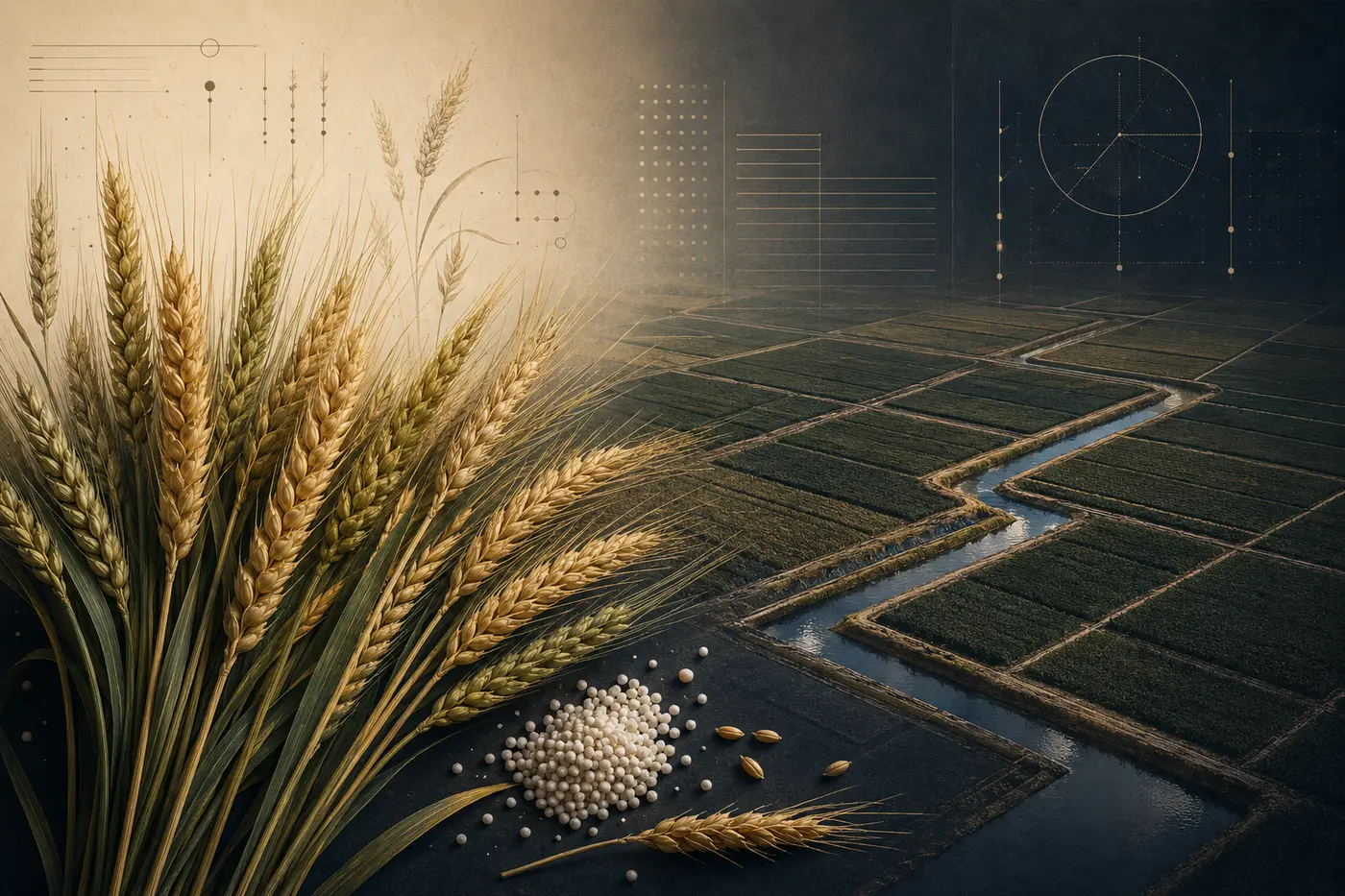
Conceptual editorial image. It illustrates the subject and is not documentary evidence.
Semidwarf wheat and rice varieties raised cereal output where irrigation, nutrients, research, credit and policy supported them.
Why This Matters
Few phrases in modern history carry as much praise and accusation as “the Green Revolution.”
In one telling, new wheat and rice varieties rescued rapidly growing countries from famine. In another, an industrial model imposed fertilizer, pesticides, debt and ecological damage on farmers. Both stories contain evidence. Neither is complete.
The Green Revolution was not a single seed, scientist or chemical. It was a package: crop breeding, irrigation, fertilizer, pest control, agricultural research, extension, credit, prices, roads and state capacity. Where enough of those pieces came together, cereal harvests rose dramatically. Where water, markets or public institutions were missing—or where the crops and environments did not fit—the transformation arrived late, unevenly or not at all.
That makes its legacy more useful than either a miracle story or an indictment. It shows how a technical breakthrough becomes a system, how a system distributes gains unevenly, and how solving one constraint can expose the next.
By the middle of the twentieth century, population was rising quickly across much of Asia and Latin America. Political leaders faced a practical fear: domestic food production might not keep pace. Expanding cultivated land could damage forests and fragile soils, while dependence on imported grain left countries exposed to foreign supply and policy.
Plant breeders pursued a different route—raising output from land already being farmed.
Traditional wheat and rice plants often grew tall. When supplied with additional nutrients, they could produce more biomass, but their stems were prone to lodging: bending or collapsing before harvest. Breeders crossed varieties to produce shorter, sturdier plants that could direct more growth into grain and remain standing under heavier heads.
The famous results included semidwarf wheat varieties associated with Mexican breeding programs and IR8 rice, released by the International Rice Research Institute in 1966. IR8 was not simply discovered waiting in nature. It emerged from deliberate crosses, selection, field trials and teamwork. Nor was it the final answer. Later varieties improved disease resistance, grain quality, maturity and adaptation.
The seed alone was never the revolution.
High-yielding varieties expressed their potential most reliably when farmers could supply sufficient water and nutrients and control weeds and pests. Irrigation reduced dependence on uncertain rainfall and enabled multiple crops in some regions. Fertilizer replaced nutrients removed in larger harvests. Credit helped farmers purchase seed, pumps and inputs before earning revenue. Extension services spread agronomic knowledge. Procurement and price policies shaped whether farmers considered the investment worth the risk.
This helps explain the revolution’s geography. Early gains were concentrated in irrigated and better-connected areas growing major cereals, especially wheat and rice. Regions dominated by rainfed farming, weaker infrastructure or different staple crops often benefited later or less. “The Green Revolution” therefore describes related transitions, not one synchronized global event.
The measured gains were substantial. Economists Robert Evenson and Douglas Gollin examined the spread of modern crop varieties in developing countries from 1960 to 2000 and concluded that international crop improvement made an important contribution to productivity. Prabhu Pingali’s later review linked the Green Revolution to higher food production, lower real food prices and poverty reduction in many settings.
Those findings support a strong claim: modern varieties and the systems around them increased cereal output and reduced hunger risk for millions.
They do not support every version of the rescue narrative.
Famine is not produced by aggregate grain supply alone. War, purchasing power, distribution, transport, discrimination and government response determine who can obtain food. Higher national production can improve food security without guaranteeing adequate nutrition for every household. Cereals can supply calories while diets remain deficient in micronutrients, protein diversity or access to health services.
It is therefore safer to say that the Green Revolution expanded the physical and economic capacity to feed people. It reduced an important constraint. It did not abolish the political and social causes of hunger.
The environmental balance is similarly mixed.
Higher yields can spare land if they allow more food to be produced without clearing an equivalent additional area. That is an important benefit, although land sparing is not automatic: profitable agriculture can also encourage expansion unless institutions protect forests and other ecosystems.
Intensification created its own pressures. Poorly managed fertilizer can contribute to nitrate pollution, nutrient runoff and greenhouse-gas emissions. Pesticides can harm farm workers, wildlife and beneficial insects. Irrigation can cause waterlogging or salinization, while uncontrolled pumping can deplete aquifers. Repeated cultivation of a narrow set of favored varieties can reduce diversity in farmers’ fields, even when breeders retain broader genetic resources in collections.
These are not proof that higher-yield farming was a mistake. They are evidence that productivity was often optimized more quickly than resource stewardship.
Distribution mattered too. Farmers with secure land, irrigation, information and access to credit could adopt the package earlier and manage its risks more easily. Smallholders were not uniformly excluded; many adopted modern varieties and benefited from higher yields, employment or lower food prices. But outcomes varied with land tenure, input prices, local labor demand, gender, market access and state policy.
A technology that works on a trial plot can therefore widen an existing advantage if only some farmers can reach the conditions required to use it.
This is also why a lone-genius history misleads. Norman Borlaug became the best-known figure in wheat improvement, but the transformation depended on generations of breeders, genetic material from many places, farmers who tested and adapted varieties, irrigation engineers, national research systems, international institutes, extension workers, lenders and governments. IR8 likewise grew from institutional collaboration rather than one inspired moment.
The Green Revolution’s defining achievement was coordination: biological potential joined to physical infrastructure and public policy.
That coordination was also its vulnerability. Once regions organized around water-intensive cereals, subsidized inputs and procurement systems, changing direction became difficult. Farmers made rational choices within incentives that could collectively strain soil and water.
The historical record supports several distinctions:
- **Fact:** semidwarf and other modern varieties helped raise cereal productivity, particularly where water, nutrients, research and market systems supported them. - **Fact:** adoption and benefits differed sharply among crops, regions and farming environments. - **Fact:** intensive use of irrigation, fertilizer and pesticides produced significant environmental costs in some places. - **Interpretation:** the revolution succeeded as a production system but was less successful as a model for nutrition, ecological resilience and universal inclusion. - **Informed possibility:** without crop improvement, much more land might have been converted to agriculture, but the amount “saved” depends on counterfactual assumptions about prices, diets, trade, policy and land protection.
The production achievement reduced scarcity while leaving uneven access, ecological pressure and nutrition gaps outside its original target.
Therefore
The Green Revolution changed what governments expected agriculture to do.
Before it, scarcity was often treated as a limit imposed by land and climate. After it, productivity became something that research institutions could deliberately redesign. A breeding program could alter plant architecture. A dam or tube well could change the effective growing season. A procurement system could make adoption economically safer. Agricultural output became a target of coordinated innovation.
That achievement reshaped development policy. It showed that public research could produce knowledge with enormous social returns and that small genetic changes could matter at continental scale when connected to distribution networks.
It also established a pattern repeated in other systems: once a measurable bottleneck is identified, investment concentrates on solving it. Cereal yield was measurable, urgent and politically visible. Nutrition quality, groundwater depletion, pesticide exposure, farmer autonomy and biodiversity were harder to compress into one target.
What gets measured is not the only thing that matters. But it often becomes the thing the system learns to maximize.
The lesson is not that yield should have been ignored. Low productivity can lock households into poverty, raise food prices and increase pressure on land. The lesson is that a successful metric must eventually be placed inside a wider scorecard.
For agriculture, that scorecard now includes yield stability, water use, soil health, greenhouse-gas emissions, nutrient loss, biodiversity, dietary quality, labor conditions and farm income. It also includes resilience: whether a crop system can withstand heat, drought, flood, pests, conflict and volatile input prices.
This changes the meaning of “improved seed.” Improvement is not a permanent property. It is a relationship between genetics, environment, management and social need. A variety optimized for irrigated fields may fail under drought. A crop that produces more grain may be less acceptable to consumers. A uniform variety may simplify cultivation while increasing vulnerability to a new disease.
Modern breeding can respond with drought and flood tolerance, pest resistance, nutritional traits and faster adaptation. Better agronomy can target fertilizer more precisely, reduce unnecessary pesticide use and manage water more efficiently. Diverse rotations and locally adapted crops can restore resilience. Digital tools may help, but only where farmers can use and trust them.
Again, none of these works alone.
The next agricultural transition will need the same systems insight as the first, with different goals. Genetics must connect to soil and water management. Research must connect to farmers’ knowledge. Productivity policy must connect to nutrition and environmental limits. Public institutions must make beneficial changes accessible without forcing farmers to absorb every risk.
That is why “What did the Green Revolution fix?” is a better question than “Was it good or bad?”
It fixed a central production problem: how to grow far more staple grain from limited land under the conditions available in many twentieth-century farming regions. It helped lower food prices and made catastrophic scarcity less likely in countries that had feared it.
It left behind problems that its original target did not capture: depleted water, inefficient nutrient use, chemical exposure, narrowed cropping systems, unequal access and the gap between sufficient calories and healthy diets.
Some of those were unintended consequences. Others were known tradeoffs tolerated because the immediate food challenge was severe. Still others arose from policies that continued after their original rationale weakened.
The achievement and the debt belong in the same history.
The next agricultural transition must preserve productivity while widening the scorecard to resilience, resource stewardship and access.
What Next
The future does not require choosing between twentieth-century productivity and a romantic return to low-yield agriculture. It requires making the production system answer more questions at once.
Can a field produce enough while using less water and losing fewer nutrients? Can breeders increase resilience without narrowing the genetic base? Can policy reward soil protection and crop diversity as reliably as it once rewarded tonnes of wheat or rice? Can small farmers gain access to useful innovation without becoming dangerously dependent on debt or a single supplier? Can higher agricultural output improve diets rather than merely increase cheap calories?
The Green Revolution demonstrated that deliberate, coordinated innovation can change the boundary of what seems possible. Its unfinished lesson is that every solved constraint changes the system around it.
The seeds mattered. So did the canals, laboratories, prices, credit, roads and institutions.
What comes next will depend on widening the definition of success without losing the capacity to deliver it.
The Green Revolution was a coordinated system of genetics, infrastructure, inputs and institutions—not a single seed or scientist.
References
Sources are listed in Harvard author–date format. Links are provided where a stable public record is available.
- Pingali, P.L. (2012) ‘Green Revolution: Impacts, limits, and the path ahead’, Proceedings of the National Academy of Sciences, 109(31).
- Evenson, R.E. and Gollin, D. (2003) ‘Assessing the Impact of the Green Revolution, 1960 to 2000’, Science, 300(5620).
- International Rice Research Institute (n.d.) ‘Changing the world with seeds: The breeding history of IR8’.
- International Rice Research Institute (2016) Celebrating 50 Years of IR8.
- Food and Agriculture Organization of the United Nations (2009) An Assessment of the Impact of Agricultural Research in South Asia since the Green Revolution.
- Food and Agriculture Organization of the United Nations (2011) The State of the World’s Land and Water Resources for Food and Agriculture.
Further reading
- Pingali (2012) for a balanced impact and limits synthesis.
- Evenson and Gollin (2003) for the global crop-improvement assessment.
- IRRI for the institutional breeding history of IR8.