How the Weekend Became a Social Institution
The two-day break was assembled from worship, labor struggle, industrial practice and law—and its protections remain uneven.
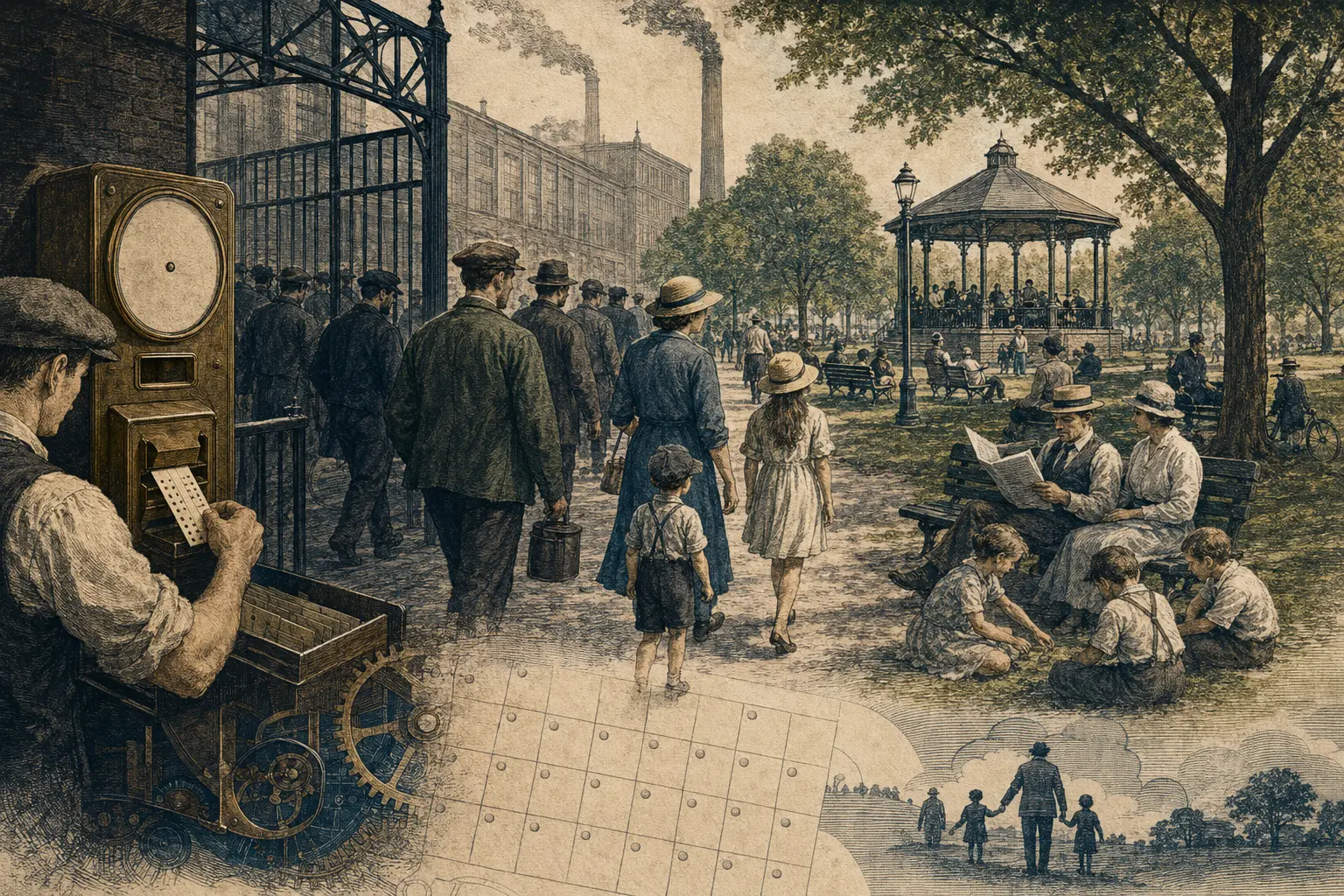
The weekend emerged when industrial time, labor organization, commerce and public custom converged around a protected interval of shared rest. Then and Therefore Editorial Team. Conceptual editorial image generated for this article; it is not documentary evidence.
Religious rest, shorter-hours campaigns, Saturday half-holidays, employer experiments and labor standards gradually assembled the modern weekend.
Why This Matters
The weekend feels natural because it arrives every seven days. Friday ends, Saturday opens, Sunday closes, and Monday waits with all the tact of an unpaid invoice.
Yet a shared two-day break is not a gift from the calendar. It is a social institution: a negotiated boundary between paid work, worship, family life, leisure and recovery. It took shape unevenly through religious practice, labor organizing, employer experiments, industrial scheduling and law. In many places it remains incomplete. Some workers have two protected days together; others have rotating rest, one weekly day, fragmented hours or no reliable boundary at all.
The familiar story credits one enlightened employer with inventing the five-day week. That version is neat and wrong. Henry Ford helped popularize the five-day, forty-hour schedule in American mass industry in 1926, but workers had demanded shorter hours for generations. Jewish Sabbath observance, Christian Sunday rules, the English “Saint Monday” custom, Saturday half-holidays, union bargaining and national labor standards all contributed to the institution that later came to look inevitable.
The weekend matters because time off is not only private leisure. When many people are free at the same time, schools, shops, transport, sport, worship and family routines organize around that shared expectation. A day of rest becomes infrastructure.
For much of agrarian history, work did not fit cleanly into a modern weekly schedule. Farming followed seasons, weather and daylight. Domestic labor rarely stopped at a clock. Religious calendars nevertheless created recurring interruptions. Jewish law centered a Sabbath from Friday evening to Saturday evening. Christian societies developed Sunday observance, although what counted as prohibited work varied by place, period and class.
Industrialization made working time more measurable and more contested. Factories concentrated workers under clocks, supervisors and machinery whose owners wanted expensive equipment used for long hours. The result was not simply “people worked more.” Some preindustrial labor had also been punishing. The important change was that hours became standardized, recorded and bargained over inside a disciplined production system.
Nineteenth-century campaigns commonly focused first on the length of the working day. The demand for “eight hours for work, eight hours for rest, eight hours for what we will” condensed a political claim into an understandable division of the day. Shorter-day movements spread through unions, reform organizations and strikes. Victories came industry by industry and jurisdiction by jurisdiction, often after conflict.
Saturday changed more gradually. In Britain, Saturday half-holidays expanded in some trades during the nineteenth century. They could accommodate religious and social expectations, reduce the disorder associated with irregular absence, and create time for shopping or recreation. The growth of spectator sport was both a beneficiary and a reinforcer: a common free afternoon created an audience.
The United States added a different pressure. Jewish workers and employers faced a week structured around Christian Sunday closure. Observing Saturday as well could mean losing two days’ wages or production. A Saturday–Sunday weekend could therefore serve religious accommodation, labor reform and industrial coordination at once, even though those motives did not always align.
International standards reveal the sequence. The International Labour Organization’s first convention in 1919 sought an eight-hour day and a forty-eight-hour industrial week—still usually six eight-hour days. The Forty-Hour Week Convention adopted in 1935 went further, recognizing reduced weekly hours as a social objective. Its adoption did not instantly create a universal weekend; ratification and national practice varied. But the progression shows that the two-day break rested on a prior political struggle over hours.
Ford’s decision belongs inside this longer story. In 1926 Ford Motor Company moved major operations toward a five-day, forty-hour week. The policy attracted attention because Ford was a large, visible manufacturer and because the schedule joined shorter hours to mass consumption. Workers with leisure could become customers. Rest, productivity and purchasing power appeared as parts of one industrial system.
Ford did not act outside power or self-interest. Earlier company welfare policies had intruded deeply into employees’ lives, and assembly-line work could be intensely controlled. The five-day week could improve recruitment, retention and machine scheduling while strengthening Ford’s public reputation. A reform can benefit workers and employers for different reasons.
Nor did one corporate policy settle the matter. In the United States, union bargaining and federal law pushed the forty-hour week toward a wider norm. The Fair Labor Standards Act of 1938 established overtime rules and progressively lowered the statutory threshold to forty hours for covered workers by 1940. Coverage contained major exclusions, and the law regulated pay for longer hours rather than simply forbidding them. Agriculture, domestic work and many other forms of labor did not receive equal protection.
Other countries followed different paths. Some built shorter weeks through sectoral bargaining; some legislated weekly rest before forty-hour limits; some placed the common days off on Friday and Saturday to fit religious and commercial patterns. The “weekend” is therefore a family of institutions, not one globally identical invention.
Synchronized time off became social infrastructure, but shift work, unpaid labor and insecure schedules distribute its benefits unequally.
Therefore
Once established, a common break changed more than the factory calendar. It gave households a shared planning horizon. Retail, tourism, broadcasting and professional sport built business models around concentrated leisure. Roads and railways developed predictable peaks. Schools and childcare assumed that many parents would be available on particular days. Religious observance became embedded in civil schedules even for people who did not share the underlying faith.
That coordination creates value. Two people with the same amount of free time do not have the same social opportunity if their hours never overlap. A synchronized weekend makes visits, clubs, worship, matches and public events easier. It transforms time off from an individual absence into a collective resource.
It also creates boundaries worth defending. The weekend tells an employer, at least in principle, that not every hour is available for purchase. This is why disputes over weekend work are rarely only about preference. They concern bargaining power, premium pay, family routines and the right to be unreachable.
But the institution distributes its benefits unevenly. Healthcare, transport, hospitality, retail, logistics, security and emergency services must operate while others rest. Shift workers may receive days off, but not the same days as family and friends. Platform and gig work can offer flexibility while transferring the problem of unstable demand to the worker. Salaried professionals may officially have weekends while carrying messages and unfinished tasks into them.
Unpaid work complicates the picture further. A paid-work weekend can become a concentrated period of cooking, cleaning, eldercare and childcare. Historically and today, women have often carried more of that labor. Counting only contracted hours can make leisure appear more equal than it is.
The institution also remains geographically uneven. The ILO’s standards express principles, not a single worldwide schedule. National law, enforcement, informality and sectoral practice differ. In economies where workers depend on multiple jobs or day wages, the formal right to rest may exist without the income security required to use it.
The weekend therefore did not abolish work. It made a claim about when work should stop, who should bear the cost of stopping, and whether society values coordinated time outside production.
Future shorter-week reforms must change workload and coverage, preserve common time and protect workers whose schedules do not fit the office norm.
What Next
Digital work has weakened the old boundary without formally repealing it. A message can cross the factory gate because there is no gate. Remote work can return commuting time and offer genuine autonomy, but it can also spread work across evenings and days off. The practical question is no longer only how many hours people work. It is whether those hours remain bounded and predictable.
Several principles follow from the weekend’s history.
First, shorter time succeeds when institutions change with it. Simply compressing the same workload into fewer days can create longer shifts, hidden overtime or intensified work. A four-day week is not automatically humane if targets remain untouched.
Second, synchronized rest still matters. Individual flexibility is valuable, but a society composed entirely of personalized schedules can lose common time. Schools, care systems and public life cannot coordinate through private preference alone.
Third, exclusions deserve more attention than headline averages. A national “average workweek” can improve while insecure workers carry volatile schedules and unpaid labor remains invisible. Good policy asks who receives predictable rest, not merely whether the mean number of hours declined.
Finally, the weekend should be understood as maintained infrastructure. It persists because contracts, law, custom, transport, schools and households continue to honor it. Remove enough of those supports and the institution can erode without any legislature voting to abolish it.
The weekend was assembled, not discovered. That is encouraging. What societies build, they can repair. The durable achievement was never Saturday and Sunday printed in a different color. It was the decision that human time has purposes the market does not get to define alone.
The weekend’s real achievement was not a colored calendar square, but a boundary around time the market does not own.
References
Sources are listed in Harvard author–date format. Links are provided where a stable public record is available.
- International Labour Organization (1919) Hours of Work (Industry) Convention, 1919 (No. 1).
- International Labour Organization (1935) Forty-Hour Week Convention, 1935 (No. 47).
- Ford, H. (1926) Statements on the five-day week, reproduced by Teaching American History.
- Hunnicutt, B.K. (1988) Work Without End. Philadelphia: Temple University Press.
Further reading
- International Labour Organization (1919) Hours of Work (Industry) Convention, 1919 (No. 1).
- International Labour Organization (1935) Forty-Hour Week Convention, 1935 (No. 47).