The Ice That Kept a Sample of Ancient Air
Ice cores preserve direct samples of old atmosphere, climate proxies and layered chronologies—but those are not the same kind of evidence.
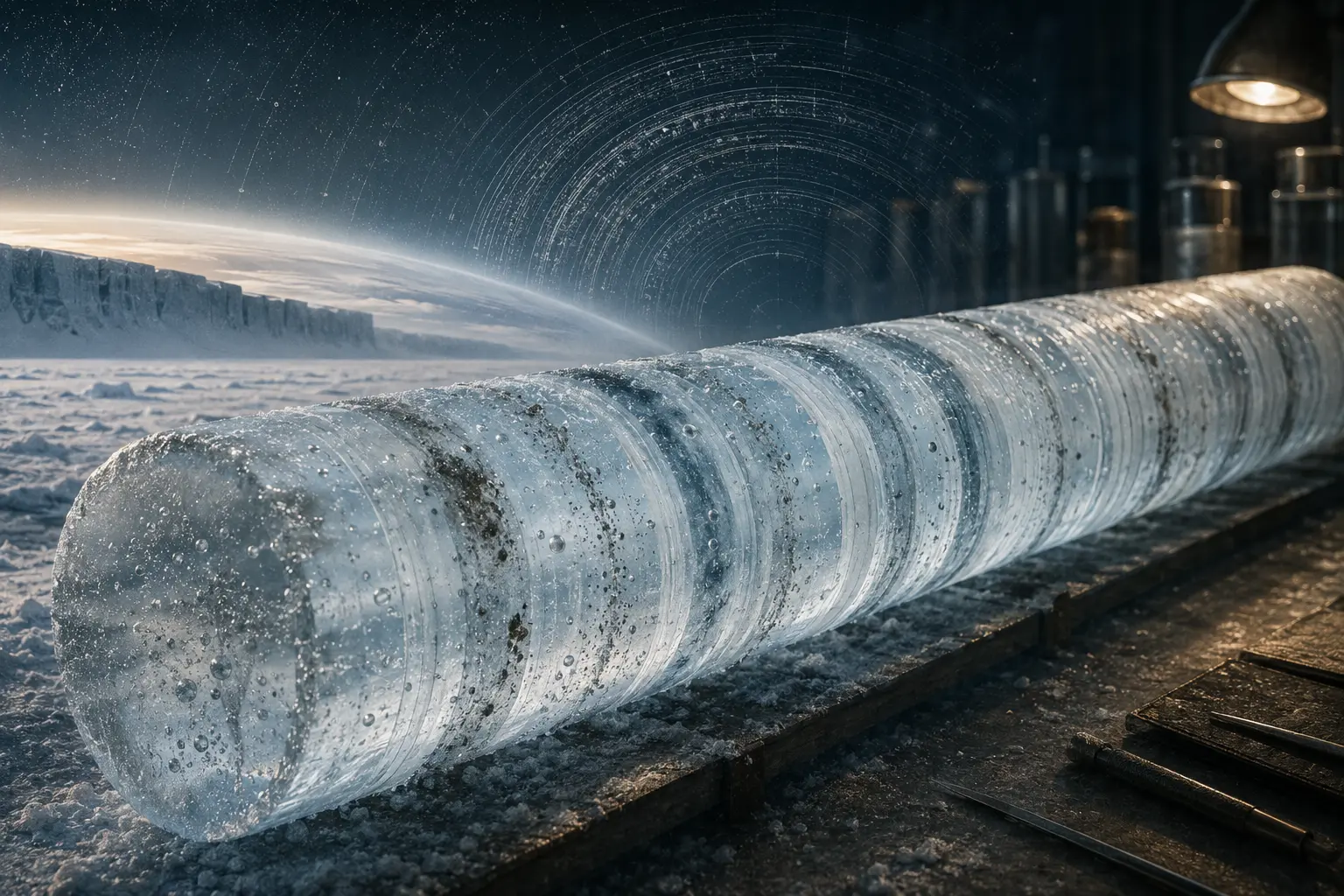
Ice cores preserve tiny samples of ancient atmosphere, sealed layer by layer. Then and Therefore Editorial Team. Conceptual editorial image generated for this article; it is not documentary evidence.
Snow compacted into ice, sealing gases and environmental traces into layered archives whose ages required careful reconstruction.
Why This Matters
There are records of the past, and then there are pieces of it.
An ice core is both.
Drilled from Greenland, Antarctica and high mountain glaciers, a core appears at first to be a long cylinder of layered ice. Inside it are chemical traces carried by snow, dust blown across continents, ash and sulfate from eruptions, isotopes shaped by temperature and moisture—and tiny bubbles containing air that once moved freely through an ancient atmosphere.
That last feature makes ice cores unusually powerful. Historians reconstruct vanished worlds from documents. Paleoclimatologists often work through proxies: physical or chemical measurements that vary with an environmental condition. In an ice core, some measurements are proxies, while the gases in sealed bubbles are samples of past atmosphere itself.
The distinction is easy to blur. Oxygen-isotope ratios in the ice are not a preserved thermometer reading. They must be interpreted through snowfall, moisture sources, transport and site-specific calibration. Carbon dioxide and methane extracted from bubbles are direct measurements of trapped air, but even those samples have a chronology that differs from the surrounding ice. Snow becomes solid ice gradually, and the air remains connected to the surface until pores close.
Ice therefore does not offer one simple timeline. It offers several linked records, each with a method and an uncertainty.
That is why the real achievement is not merely drilling deep. It is learning how to turn depth into time, how to distinguish ice age from gas age, how to compare cores from different places and how to preserve the chain from field sample to public dataset.
The result is one of science’s most tangible encounters with deep climate history: not a story written in ink, but an archive made by weather, gravity and time.
Every ice core begins as snowfall.
In cold regions where more snow accumulates than melts, one year’s snow is buried by the next. The weight of overlying layers compresses the snow into firn—a granular stage between snow and glacial ice. Deeper still, crystals reorganize, density increases and the open pathways between grains close into bubbles.
That process stores different kinds of evidence.
The ice itself contains water molecules whose isotopic composition reflects conditions in the hydrological cycle. Oxygen and hydrogen occur in heavier and lighter forms. Their ratios in precipitation vary with temperature, evaporation, condensation and the path an air mass followed. In many polar records, lower proportions of heavy isotopes are associated with colder conditions. But the relationship is not universal or perfectly linear. Scientists calibrate it for a site and test it against other evidence.
Dust can indicate aridity, wind strength and distant source regions. Sea salts and other ions can carry information about marine conditions and atmospheric circulation. Sulfate and microscopic ash can record volcanic eruptions. Some chemical layers vary seasonally, making annual counting possible where accumulation is high and layers remain distinct.
The air bubbles form a different archive. Once sealed, they preserve mixtures of gases such as carbon dioxide, methane and nitrous oxide from the atmosphere during the time of enclosure. A laboratory can crush or melt ice under controlled conditions, extract the gas and measure its concentration or isotopic composition.
Calling this “ancient air” is accurate, but the age requires care.
The snow at a particular depth fell before the air at that same depth was fully sealed. During the firn stage, gases can continue to diffuse through connected pores. The difference between the age of the ice and the age of the gas—the delta age—depends on accumulation, temperature and firn structure. Chronologies therefore distinguish ice age from gas age and carry uncertainties for both.
Dating methods change with depth and location. Near the surface, investigators may count annual layers using visual features, isotopes, electrical properties or seasonal chemistry. Distinctive volcanic horizons can connect a core to independently dated eruptions or to other records. Deeper sections may require ice-flow models, gas correlations, orbital markers and combinations of relative and absolute dating.
Layer counting is not simply counting visible stripes with a ruler. Layers thin as ice flows and is compressed. Melt, wind erosion and uneven accumulation can disturb the record. Near bedrock, folding and deformation may disrupt chronological order. A published core chronology is therefore a scientific product: measurements, models, tie points and stated uncertainty assembled into an age scale.
Early ice-core work grew from glaciology and polar exploration, but the field changed dramatically with long cores from Greenland and Antarctica. Projects such as Vostok, the Greenland Ice Sheet Project and EPICA extended records across repeated glacial and interglacial cycles. The EPICA Dome C core provided an Antarctic climate and greenhouse-gas record covering roughly 800,000 years, while newer drilling is extending recoverable ancient ice further.
The famous graphs comparing temperature-related signals with carbon dioxide come from this work. They show repeated cycles in which greenhouse-gas concentrations and climate vary together. The relationship is not a cartoon in which one line mechanically pulls the other at every moment. Orbital changes, ice sheets, oceans, vegetation and greenhouse gases interact through feedbacks. Timing can differ by region and transition.
What the cores establish with exceptional strength is that atmospheric composition has changed with climate across long periods, and that recent concentrations can be compared against a directly sampled preindustrial and glacial atmosphere.
The archive is also geographical. A core from central Antarctica records conditions differently from one in Greenland or a tropical glacier. Snowfall, elevation, wind and nearby sources shape what is deposited. One core cannot stand for the entire planet. Scientists compare multiple cores and other archives—tree rings, corals, caves, lake and ocean sediments—to build a larger picture.
The material itself demands extraordinary care. Drilling fluid, handling and storage can contaminate a sample. Temperature changes can crack ice or alter gases. National facilities catalogue sections, maintain cold storage and allocate precious material to investigators. Data archives preserve measurements and metadata so later researchers can reassess claims or combine records.
In that sense, an ice core is not only a natural archive. It becomes a scientific archive through institutions.
Ice cores extend atmospheric and climate context far beyond instruments, but every signal remains tied to site, method and chronology.
Therefore
Ice cores changed climate history by bringing several kinds of time into the laboratory.
They allow scientists to measure ancient greenhouse gases directly from trapped air. They provide temperature-related, precipitation-related and circulation-related proxies from the ice and its impurities. They preserve abrupt events such as volcanic fallout that can link records across large distances. And they can be dated well enough to examine leads, lags and rates of change.
But the strength of the evidence depends on not collapsing these categories.
A useful hierarchy is:
- **Direct sample:** the concentration of a gas measured from air sealed in a bubble. - **Proxy measurement:** an isotope or chemical concentration interpreted as evidence about temperature, snowfall, winds or another environmental condition. - **Chronological model:** the mapping from depth to estimated age, with separate treatment for ice and gas. - **Synthesis:** the comparison of cores with one another, with other archives and with physical climate models.
When public discussion calls all of these “data from ice,” the phrase is true but incomplete. Each layer of inference answers a different question.
The record also teaches humility about precision. A core may resolve individual years in one interval and only decades or centuries in another. Gas bubbles do not all close on one day; they represent a distribution of ages. Diffusion can smooth very rapid atmospheric changes. Deep ice may be thinned or disturbed. Temperature relationships differ by site.
These are not fatal flaws hidden beneath a dramatic graph. They are the reason scientific papers publish methods, calibration, age scales and uncertainty. The record is trusted not because ice is magically transparent, but because its limitations can be studied.
The comparison with instrumental observations is especially important. Thermometers and direct atmospheric monitoring cover only a small fraction of Earth history. Ice cores extend context far beyond them. They do not replace modern measurements; they connect them to earlier baselines.
They also keep catastrophes in memory. Sulfate layers from large eruptions can help date cores and identify volcanic forcing. The Tambora eruption, for example, is part of a wider documentary and physical record that includes ice chemistry. Yet ice alone does not tell us the price of bread, the timing of hunger in one village or the political decisions that shaped relief. Natural archives and human archives answer different parts of the same historical question.
That boundary is useful. Climate evidence becomes stronger when it is specific about what it can show.
Recover threatened archives, improve tiny-sample analysis and judge claims by asking what was measured, where and how it was dated.
What Next
The future of ice-core science is partly a race against loss.
Mountain glaciers and ice caps are shrinking, threatening records that cannot be recreated once melted. Polar drilling programs seek older ice, higher-resolution recent records and sites that fill geographical gaps. The goal is not simply to set a depth record. It is to recover intervals that can test how greenhouse gases, ice sheets and climate feedbacks behaved under different conditions.
New analytical techniques can measure more compounds from smaller samples, preserving material for future work. Better firn models refine the age relationship between ice and gas. Improved synchronization links cores across hemispheres and with other archives. Open data and carefully documented chronologies make it possible to revisit older conclusions rather than treating one published graph as final.
For readers, the discipline offers a practical way to assess claims.
Ask what was actually measured. Was it a gas in a bubble, an isotope in the ice, a particle, a layer thickness or a modeled age?
Ask where the core came from. A site is not a footnote; it shapes the signal.
Ask how the chronology was built and whether the uncertainty changes with depth.
And ask whether a global conclusion rests on one core or on agreement across multiple archives and physical models.
These questions do not weaken the story. They make it more remarkable.
Snow falls without intending to keep a record. Air lingers between crystals. Dust and salt arrive from distant places. Pressure closes the pores, glaciers flow, and centuries become depth. Much later, a drill brings part of that sequence back to the surface.
Inside are clues that require interpretation—and bubbles that still contain a small sample of a vanished sky.
Trapped gas is a direct sample of past atmosphere; isotope-based temperature is a calibrated proxy.
References
Sources are listed in Harvard author–date format. Links are provided where a stable public record is available.
- NOAA National Centers for Environmental Information (n.d.) ‘Paleoclimatology’.
- NOAA NCEI (2016) ‘How Can Ice Teach Us About Climate?’.
- NASA Earth Observatory (2005) ‘Paleoclimatology: The Ice Core Record’.
- NASA (2017) ‘Core Questions: An Introduction to Ice Cores’.
- British Antarctic Survey (2010) ‘Ice cores and climate change’.
- NOAA NCEI (2008) ‘Sources of uncertainty in ice core data’.
- NOAA NCEI (n.d.) ‘West Antarctic Ice Sheet Divide chronology’.
Further reading
- NOAA National Centers for Environmental Information (n.d.) ‘Paleoclimatology’.
- NOAA NCEI (2016) ‘How Can Ice Teach Us About Climate?’.