The Number That Made Nothing Useful
Zero became powerful through distinct breakthroughs in placeholding, arithmetic and cross-cultural transmission.
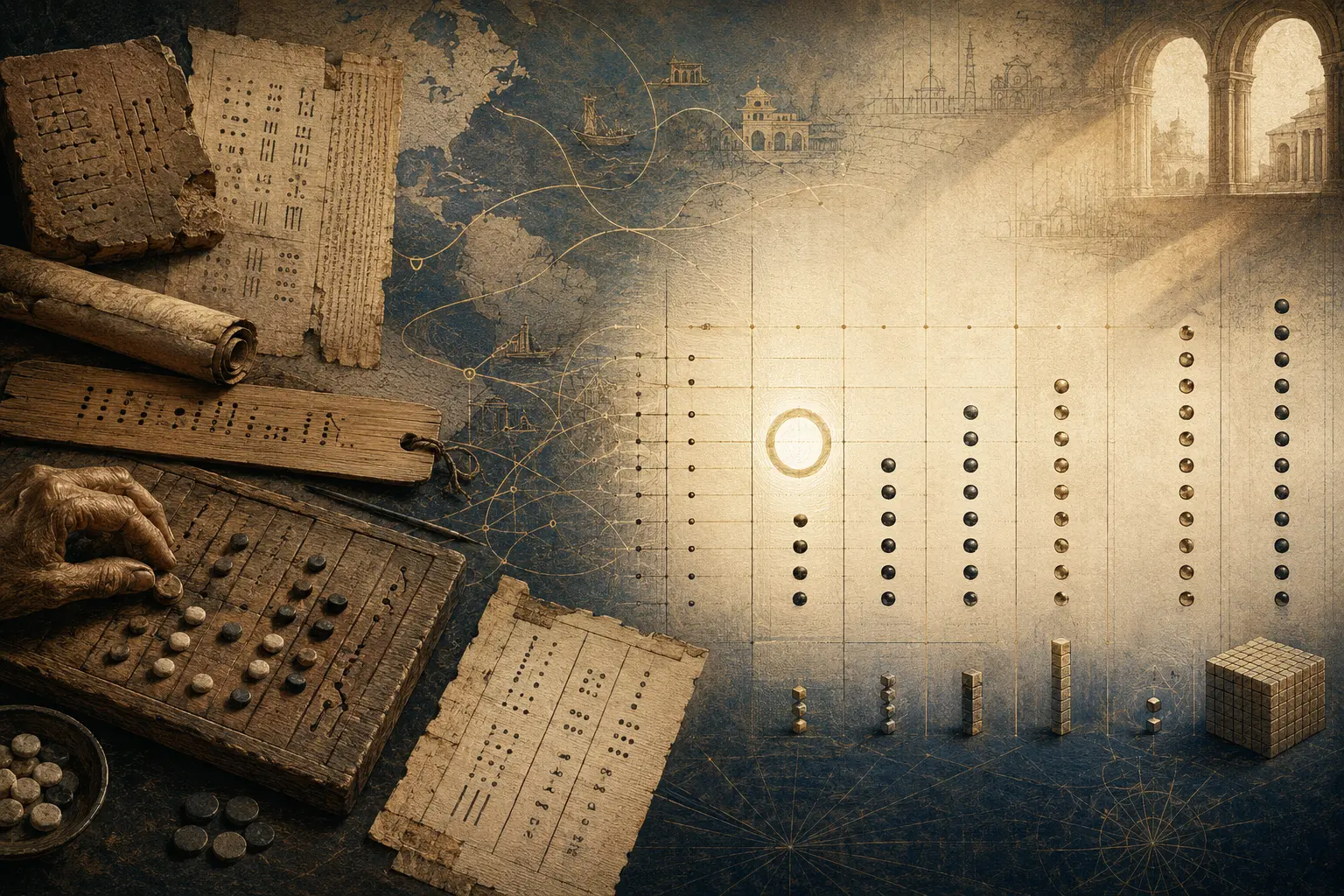
Zero made absence usable—and transformed how numbers could be written and calculated. Then and Therefore Editorial Team. Conceptual editorial image generated for this article; it is not documentary evidence.
Placeholder practices appeared independently, while Brahmagupta’s arithmetic rules and later transmission through Arabic and Latin scholarship expanded zero’s role.
Why This Matters
Zero does two jobs so quietly that we forget how strange either one is.
In 507, the zero tells us there are no tens while preserving the place of the five hundreds and seven units. In the equation \(x + 0 = x\), zero behaves as a number with arithmetic properties. Those are related achievements, but they are not identical. A culture can use an empty position in notation without fully treating “nothing” as a number that can enter calculations.
Popular history often turns this long development into a race for the first zero. Babylonian scribes, Maya astronomers, Indian mathematicians and later Islamic and European scholars are lined up as rival claimants. The result is less history than trophy ceremony.
Zero was not invented once in a finished form. Placeholder practices appeared in more than one tradition. Indian mathematicians developed especially influential rules for calculating with zero and negative quantities. Scholars writing in Arabic transmitted and expanded positional arithmetic. Translations and commercial mathematics carried it further into Europe.
The number that represents nothing became useful because many people, languages and institutions made it travel.
Place-value notation gives a symbol’s position part of its meaning. In a decimal system, a digit can represent units, tens, hundreds or larger powers according to where it stands. But place value creates a problem: how do you show that a position is empty?
Ancient Babylonian mathematics used a sexagesimal, or base-sixty, place-value system. Over time scribes employed spacing and then placeholder signs to mark an empty internal position. The notation improved clarity, but the placeholder was not the same as a freely operating number. Context still mattered, and an empty final position could remain ambiguous.
Maya calendrical and mathematical notation developed a zero sign independently in Mesoamerica. Its shell-like glyph could mark an empty place in a vigesimal, or base-twenty, system and had important calendrical uses. This history alone should end the idea that humanity faced one universal ladder toward zero climbed by a single civilization.
In South Asia, positional decimal notation and concepts of emptiness developed through a different intellectual setting. The Bakhshali manuscript contains a dot used as a placeholder. Its dating has been debated and revised; claims based on the Bodleian Libraries’ widely publicized 2017 carbon dates should therefore be handled cautiously. The manuscript is valuable evidence of a written mathematical practice, but it should not be made to carry a simplistic “oldest zero” headline.
Brahmagupta’s *Brāhmasphuṭasiddhānta*, composed in 628 CE, provides a firmer landmark. Brahmagupta stated rules involving positive quantities, negative quantities and zero. He described additions and subtractions with zero and recognized that a number minus itself is zero. His treatment of division by zero did not match modern mathematics, which is precisely why his work is historically valuable: it shows a concept under development rather than a timeless package arriving complete.
Indian terminology framed positive numbers as fortunes and negative numbers as debts. That language made signed quantities intelligible through familiar relations. Zero, or *śūnya*, belonged within the same arithmetic field. It was no longer merely a gap that protected positional notation.
The system then traveled. From the eighth century onward, scholars working in the Abbasid world studied Indian astronomical and mathematical materials. Muḥammad ibn Mūsā al-Khwārizmī wrote an influential work on calculation with Hindu numerals in the ninth century. The original Arabic text is lost, but Latin adaptations helped give Europe the word “algorithm,” derived from his name.
Transmission was not copying without thought. Mathematicians working in Arabic developed algebra, calculation manuals and astronomical techniques suited to their own problems. Numerals moved through scholarly networks and commerce, encountering other traditions such as the abacus and Roman notation.
In Latin Europe, Leonardo of Pisa—Fibonacci—promoted what he called the nine Indian figures and the sign *zephirum* in *Liber Abaci* in 1202. Merchants could use positional numerals for currency conversion, interest, weights and bookkeeping. Yet adoption was not immediate. Existing practices worked, users distrusted unfamiliar marks, and handwritten numerals could be altered. A superior notation still needed training, institutions and reasons to switch.
The European word followed the route: Sanskrit *śūnya* was rendered through Arabic *ṣifr*, which became Latin *zephirum* and later Italian *zero*. “Cipher” shares the ancestry. The vocabulary preserves the fact that mathematical ideas arrive with translations attached.
Representing an empty place and calculating with zero made written algorithms more compact, scalable and transferable.
Therefore
Zero made written calculation more scalable. A compact positional system can represent very large and very small quantities without a new symbol for every magnitude. Standard algorithms for addition, subtraction, multiplication and division become easier to teach and reproduce.
This did not mean people without zero could not calculate. Roman numerals coexisted with counting boards; merchants and officials used tools adapted to their tasks. The change lay in what could be performed directly in notation and transmitted on paper.
Zero also transformed algebra. Setting an expression equal to zero provides a common way to define roots and rearrange equations. Coordinate systems use zero as an origin. Calculus studies quantities approaching zero. Modern physics defines reference points and ground states carefully because “zero” can mean absence, baseline or chosen origin depending on the quantity.
Computing adds another famous association: binary notation uses 0 and 1. But it would be misleading to draw a straight causal line from Brahmagupta to the digital bit. Binary systems have their own histories, and electronic switching is a physical implementation. The deeper connection is structural: symbolic systems become powerful when absence and position can be represented reliably.
Zero carries philosophical temptations too. Mathematical zero is not identical to metaphysical nothingness. An empty bank balance, absolute vacuum, zero degrees and the origin of a graph do not describe the same kind of absence. The symbol works because each system defines what its zero means.
That distinction matters outside mathematics. Baselines are decisions. “Zero risk,” “zero emissions” and “zero tolerance” may sound absolute while depending on boundaries, measurement and exceptions. The clarity of the symbol can hide the complexity of the definition.
Innovation histories should distinguish concept, notation, rules and transmission—and treat dating uncertainties and translators as part of the evidence.
What Next
The history of zero offers a better model of innovation than the lone-inventor myth.
First, distinguish the problem from the mature concept. Marking an empty position, treating zero as a number, defining arithmetic rules and spreading a notation are different achievements.
Second, treat errors as evidence of development. Brahmagupta’s difficulty with division by zero does not diminish his importance. It reveals where a powerful framework had reached its edge. Mathematics advances by making such edges explicit.
Third, follow the translators. Ideas compound when they cross languages, institutions and practical settings. Al-Khwārizmī, later Arabic commentators, Latin translators, Fibonacci, teachers and merchants were not couriers carrying an untouched object. They were part of the invention’s continuing life.
Finally, be skeptical of “oldest” claims when the evidence is fragmentary or newly dated. A manuscript’s material date, the composition date of its text and the date a particular notation was added may differ. Precision in the headline can exceed precision in the archive.
Zero made nothing useful by giving absence a place inside a system. Its deeper lesson is not that one civilization discovered emptiness. It is that human beings learned, across several traditions, to make a missing quantity visible—and then to calculate with what was not there.
Zero made absence useful by giving it a defined place inside a system.
References
Sources are listed in Harvard author–date format. Links are provided where a stable public record is available.
- Brahmagupta (628) Brāhmasphuṭasiddhānta, Chapter 18, in scholarly translation.
- Plofker, K. (2009) Mathematics in India. Princeton: Princeton University Press.
- University of Oxford, Bodleian Libraries (2017) Materials on the Bakhshali manuscript; dating claims require later-revision caution.
- Fibonacci (1202) Liber Abaci, trans. L.E. Sigler (2002). New York: Springer.
Further reading
- Brahmagupta (628) Brāhmasphuṭasiddhānta, Chapter 18, in scholarly translation.
- Plofker, K. (2009) Mathematics in India. Princeton: Princeton University Press.